SaaS Boilerplate Your App Development Accelerator
So, what exactly is a SaaS boilerplate?
Think of it as a professional-grade starting kit for a software company. It’s a pre-built code foundation that already has all the common, must-have features every SaaS application needs—things like user sign-ups, login pages, and subscription billing.
Instead of laying every single brick yourself, you start with the essential structure already in place. This lets you jump straight to building the unique, interesting parts of your product that customers will actually pay for. It’s a massive head start that can save you weeks, if not months, of tedious work.
A SaaS Boilerplate in Action: The Restaurant Analogy
Imagine you’re a brilliant chef ready to open a new restaurant. You have two choices.
Option one: You buy an empty plot of land. You’ll have to dig trenches, lay plumbing, run electrical wiring, and install ventilation systems from scratch. You’re a plumber and an electrician for months before you even think about cooking.
Option two: You lease a space where a previous restaurant has already done all that foundational work. The kitchen is already equipped with sinks, power, and vents. You can walk in on day one and start designing your menu and perfecting your recipes.
A SaaS boilerplate is that fully-equipped kitchen for your software idea. It handles all the repetitive but critical infrastructure so you can focus on what you do best—building your product.
What’s Already in the Kitchen?
A good boilerplate isn’t just a random collection of code. It’s a cohesive system where all the core pieces are already connected and designed to work together smoothly.
Most production-ready boilerplates come with these essentials built-in:
- User Authentication: Secure sign-up, login, password resets, and even social logins with providers like Google. This stuff is tricky to get right and absolutely critical for security.
- Subscription Billing: Pre-built integration with payment processors like Stripe to handle plans, recurring payments, and invoices without you having to write all the complex logic yourself.
- Team and User Management: The ability for users to invite team members, assign roles, and manage permissions.
- Admin Dashboard: A backstage area for you to manage users, check on business metrics, and keep an eye on your application.
Now, you might see the term “boilerplate code” used for simple, reusable snippets, like in this basic example from Wikipedia.
But a modern SaaS boilerplate takes this idea and expands it into an entire, interconnected application foundation. It’s the whole kitchen, not just the recipe for a single sauce.
A boilerplate’s real job is to get the boring, complicated stuff out of your way. It lets you skip hundreds of hours of grunt work and pour that energy into the features that solve your customers’ actual problems.
This isn’t just a convenience; it’s a massive competitive edge. The global SaaS market is projected to hit $793.1 billion by 2029, which means the competition is fierce. Speed and quality matter more than ever. You can read more about these SaaS industry trends to see just how fast things are moving.
The Anatomy of a Production-Ready Boilerplate
Let’s be clear: not all boilerplates are created equal. Many will give you a basic starting point, but a truly production-ready SaaS boilerplate is a completely different animal.
Think of it like building a house. A basic boilerplate is the wood frame—it gives you the shape, but that’s about it. A production-ready boilerplate is a fully inspected structure with the plumbing, electrical, and security systems already installed and up to code. You just need to add the finishing touches.
Let’s break down the non-negotiable components that make up that solid foundation.
This diagram shows the core pillars that hold up a modern SaaS application.
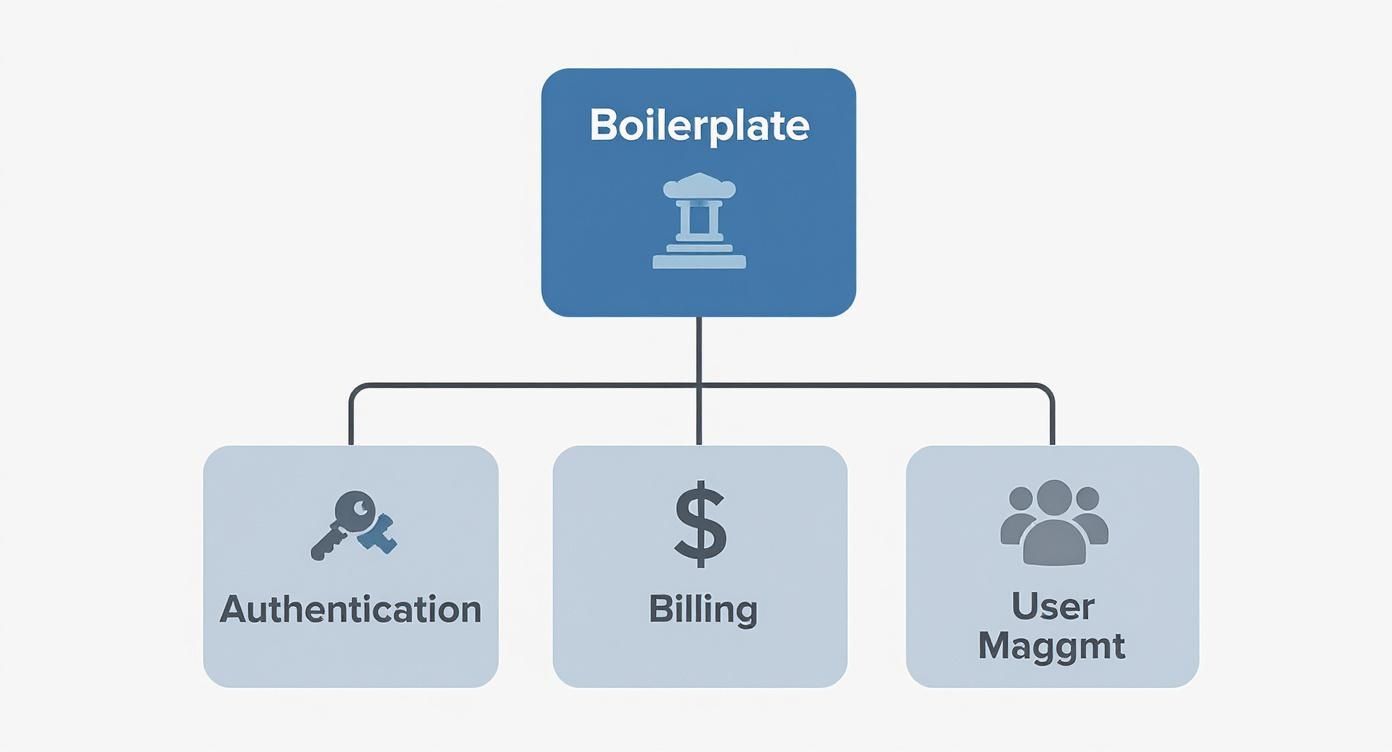
As you can see, features like authentication, billing, and user management aren’t just nice-to-haves. They are the fundamental systems that every SaaS business depends on to function securely and profitably from day one.
To get a clearer picture, it’s helpful to see what separates the basic starter kits from the serious, scalable solutions.
Essential vs. Advanced SaaS Boilerplate Features
| Feature Category | Essential (Found in Most Boilerplates) | Advanced (Critical for Scalability) |
|---|---|---|
| Authentication | Basic email/password login. | Social logins, MFA, passwordless, Role-Based Access Control (RBAC). |
| Billing | Simple one-time payment integration. | Full subscription management (tiers, trials, upgrades/downgrades), failed payment handling, coupon systems. |
| Team/User Management | Individual user accounts. | Multi-tenancy (Organizations/Teams), seat management, team invitations. |
| Admin Panel | Rudimentary user list. | A full-featured dashboard with user impersonation, analytics, and subscription management. |
| Infrastructure | Code only; requires manual setup. | Pre-configured deployment, production database, email sending services. |
This table highlights the leap from a simple project starter to a true business foundation. Now, let’s dig into what those advanced features actually mean for your business.
Robust Authentication and Authorization
Your app’s front door has to be both welcoming and secure. A production-ready boilerplate handles the entire authentication flow, saving you hundreds of hours of complex, security-critical development work. This is way more than just a simple email and password form.
It includes:
- Social Logins: One-click sign-up using providers like Google or GitHub. This small feature can make a huge difference in your conversion rates.
- Multi-Factor Authentication (MFA): An essential security layer that protects user accounts from being taken over. This is often a deal-breaker for enterprise clients.
- Role-Based Access Control (RBAC): A system for defining user roles (like admin, editor, or viewer) and limiting what they can see and do.
Trying to build all this from scratch is not only a massive time sink but also incredibly risky. One mistake in your auth logic could expose your entire user base.
Seamless Subscription Billing
Let’s face it, getting paid is the whole point. A boilerplate with pre-built billing integration is priceless, saving you from the headache of dealing directly with payment processors like Stripe. This goes way beyond just charging a credit card a single time.
A key job of a SaaS boilerplate is to handle the repetitive, error-prone logic of recurring revenue. It manages subscription tiers, trial periods, upgrades, downgrades, and dunning (failed payment reminders) so you don’t have to.
This system makes your revenue stream reliable and automatic. It correctly handles webhooks from Stripe to keep user subscription statuses perfectly in sync with their payments—a task that’s notoriously tricky to get right. Forgetting to revoke access after a customer’s payment fails is a classic way to lose money.
User and Team Management
Modern SaaS is all about collaboration. That means your app needs to support not just individual users, but entire teams or organizations. A capable boilerplate provides this multi-tenancy infrastructure right from the start.
Key components here are:
- Team Invitations: A smooth flow for users to invite their colleagues to join their workspace.
- Organization Switching: An easy way for users who belong to multiple teams to switch between them.
- Seat Management: The built-in logic to handle per-seat billing, a super common SaaS pricing model.
Getting this right from the beginning ensures your app can scale from serving solo founders to entire enterprise teams without needing a massive, painful rewrite down the road.
The Pre-Configured Admin Dashboard
Finally, you need a control center to actually run your business. A pre-configured admin dashboard gives you immediate visibility into what’s happening.
Instead of running manual database queries to answer a support ticket, you can just look up a user, see their subscription status, and solve their problem from a secure interface. Building your own internal tools is a huge distraction, which is why so many developers turn to admin panel and CRUD generators to speed things up.
A production-ready boilerplate delivers this right out of the box, giving you the operational tools you need from the moment you launch. It’s the final piece that turns a pile of code into a manageable business.
The Hidden Costs of a Weak Foundation
Picking a SaaS boilerplate can feel like hitting the jackpot—a shortcut that gets your product to market in record time. But be careful. Opting for a cheap, unmaintained, or poorly structured boilerplate is like building a skyscraper on a foundation of sand. It might stand tall on day one, but a catastrophic failure is all but guaranteed.

That initial burst of speed you get from a weak boilerplate quickly becomes an anchor dragging you down. What begins as a clever shortcut almost always ends in a complete, soul-crushing rebuild that costs far more than just choosing a solid foundation from the start.
The Slow Poison of Technical Debt
Think of technical debt as the cost of rework you create by picking an easy, quick-fix solution now instead of the right one. A fragile boilerplate is a technical debt factory, and you’re inheriting every single shortcut its creator took. Every outdated dependency, every poorly written function—it’s all yours now.
At first, you can manage it. You work around the weird quirks and patch the most glaring holes. But as your application grows, that debt starts compounding interest. Simple feature requests turn into week-long ordeals because your developers are constantly fighting the boilerplate’s tangled architecture just to make a tiny change.
“A cheap SaaS boilerplate doesn’t save you money; it just defers the cost. You pay for it later with developer burnout, missed deadlines, and a product that’s impossible to maintain or scale.”
Eventually, the codebase becomes so brittle that any forward momentum grinds to a halt. This is the moment many startups face a gut-wrenching decision: limp along with a broken product or burn months of progress on a total rewrite.
Security Vulnerabilities: A Ticking Time Bomb
One of the scariest parts of a neglected SaaS boilerplate is its security—or lack thereof. Software dependencies need constant updates to patch vulnerabilities as they’re discovered. If the person who built your boilerplate walked away from the project a year ago, you’re basically running on code with known, publicly documented security flaws.
This leaves your application and, more importantly, your users’ data wide open. The risks are very real:
- Outdated Authentication Logic: Flaws could let attackers slip past logins or grant themselves admin privileges.
- Vulnerable Dependencies: Using old versions of common libraries (like Express or Next.js) can expose your app to critical, well-known exploits.
- Improper Data Handling: Weaknesses in how the boilerplate stores passwords or session tokens can lead to catastrophic data breaches.
Fixing this mess requires a deep security audit and a ton of engineering time—exactly the kind of work you thought the boilerplate was supposed to save you from.
When Scalability Hits a Wall
A boilerplate might work just fine with ten users. But what happens when you hit ten thousand? A poorly designed foundation will crumble under the load. You’ll see slow performance, database bottlenecks, and frequent, embarrassing crashes.
This is a deal-breaker in competitive markets. North America, for example, makes up 46% of the global SaaS market, a space defined by sky-high user expectations. A boilerplate that can’t handle growth means you simply can’t compete. You can learn more about the demands of the global SaaS market and see why performance is everything.
The inability to scale isn’t just a tech problem; it’s a business-ending one. You can’t onboard new customers if your platform keeps falling over, turning your marketing wins into a customer support nightmare. A solid foundation like saasbrella is built for production scale from the very beginning, so these architectural gaps are addressed before they become five-alarm fires.
The Build vs. Buy SaaS Boilerplate Framework
For any founder or CTO, this is one of the big ones: do we build our own infrastructure from the ground up, or do we buy a pre-built SaaS boilerplate? This isn’t just a tech question—it’s a critical business decision that will echo for years. Instead of a simple pros-and-cons list, let’s walk through a proper framework to help you make the right call for your specific situation.
The very first step is to take a hard, honest look at your team’s real-world skills. Do you actually have a payments expert on hand who deeply understands the mess of Stripe webhooks, dunning, and global tax compliance? Is there a dedicated security engineer who lives and breathes robust authentication, role-based access control, and MFA?
If the honest answer is “no,” then building these systems yourself means your team is learning on the job. That’s a huge gamble when your product’s security and your company’s revenue are on the line.
Calculating the True Opportunity Cost
The real killer here is often the opportunity cost. Every single hour your engineers spend building generic features—like user sign-ups or subscription logic—is an hour they aren’t spending on your product’s unique magic. You know, the stuff that actually solves your customers’ problems and makes you different from everyone else.
Think about it this way: building a production-ready authentication and billing system from scratch can easily tie up a small team for 3-6 months. What game-changing, customer-facing features could you build, ship, and get feedback on in that same time? The cost of building isn’t just salaries; it’s the lost revenue and market momentum from a launch that’s months behind schedule.
The real question isn’t “Can we build this?” It’s “Should we?” If a feature doesn’t directly contribute to your unique selling proposition, you need to seriously question why you’re dedicating your most precious resource—engineering time—to it.
The Long-Term Maintenance Burden
And the fun doesn’t stop after the initial build. That custom-built infrastructure now needs constant babysitting. We’re talking ongoing maintenance, security patches, and endless updates. When a new vulnerability pops up in an open-source library, your team has to drop everything to fix it. When a payment provider changes its API, your team has to scramble to handle the migration.
This creates a permanent drag on your ability to move fast. By using a commercial SaaS boilerplate, you’re essentially outsourcing that entire maintenance headache to a dedicated team. Their whole job is to keep that foundation secure, updated, and reliable. This is a huge part of the professional services provided by solutions like saasbrella—we make sure your foundation stays solid so you can focus on building your business.
So, when does it actually make sense to build versus buy?
- Build Your Own Boilerplate When: You have intensely niche, non-standard requirements that no existing solution can possibly meet, and you have the in-house expertise and long-term budget to maintain it all. Honestly, this is incredibly rare for an early-stage startup.
- Buy a SaaS Boilerplate When: You need to get to market fast, want to pour all your resources into your core product, and need a battle-tested, secure, and scalable foundation for all the standard SaaS stuff. This is the winning move for over 95% of new SaaS ventures.
By being brutally honest about your team’s skills, the real opportunity cost, and the hidden maintenance tax, you can make a strategic choice that actually aligns with your business goals and gets you to market faster.
How to Choose the Right SaaS Boilerplate
Picking a SaaS boilerplate is a lot like choosing the foundation for a house. Get it right, and you have a solid base to build your business on. Get it wrong, and you’ll be dealing with cracks and leaks for years. It’s easy to get distracted by a long list of flashy features, but the real value is in the core engineering.
Your very first filter should be the tech stack. It’s a dealbreaker. The boilerplate has to align with your team’s skills and your product’s needs. If your team lives and breathes React and Next.js, choosing a boilerplate built on a totally different framework is just setting yourself up for a painful—and pointless—learning curve.
Nail the Technology and Architecture
Before you even think about a demo, pop the hood and look at the core tech.
You need to ask a few key questions:
- Frontend Framework: Is it built on something modern and widely supported like Next.js, SvelteKit, or Nuxt? Make sure it’s a tool your team actually wants to use.
- Backend Language: What’s running on the server? Is it TypeScript, Python, or another language your team can confidently work with and extend?
- Database and ORM: Does it use a rock-solid database like PostgreSQL paired with a well-known ORM like Prisma? This combo saves you from a world of headaches when it comes to managing data.
But it’s not just about the specific tools. You have to understand the architectural philosophy. Is this boilerplate a tightly-wound monolith, or does it have a more modular, modern design? A monolith might feel simpler at first, but a modular architecture will be infinitely easier to scale and maintain as your app gets more complex.
Don’t Underestimate Documentation and Support
A boilerplate with amazing code but no documentation is a trap. It’s a black box. You’ll waste more time trying to figure out how it works than you would have spent just building from scratch. Good documentation isn’t a “nice-to-have”—it’s the instruction manual for your entire foundation.
Look for clear, detailed guides that cover the essentials:
- Getting Started: A simple, step-by-step guide to get the project running on your local machine.
- Configuration: Clear instructions for plugging in your own API keys for services like Stripe, SendGrid, and social login providers.
- Core Concepts: Plain-English explanations of how the big pieces—like authentication, multi-tenancy, and billing—are put together.
- Deployment: A practical guide to getting your app live on a real hosting provider.
Support is just as critical. Is there an active community, like a Discord server, where you can get help? Does the creator actually answer questions? A thriving, helpful community is one of the best signs that a project is well-maintained and trusted by other devs.
When you choose a boilerplate, you’re not just buying code; you’re investing in an ecosystem. Strong documentation and active support are what turn a static template into a living, evolving foundation for your business.
Take It for a Test Drive
You wouldn’t buy a car without driving it first, right? The same logic applies here. Before you commit, you need to get your hands dirty with the code. If it’s open-source, clone the repo. If it’s a paid product, ask for a trial or access to a sample repository.
Once you’re in, start poking around:
- Code Quality: Is the code clean, organized, and easy to read? Can you follow the logic for a basic feature like user sign-up? Spaghetti code is a massive red flag.
- Commit History: Check the Git history. Is the project actively maintained with frequent, meaningful updates? An abandoned project is a ticking time bomb.
- Extensibility: Try a thought experiment. Imagine you need to add a brand new, custom feature. Does the boilerplate’s structure make that feel easy, or does it feel like you’d be fighting against its design choices?
A good boilerplate should also have one eye on the future. AI integration, for example, is becoming table stakes. The AI-powered SaaS market is projected to grow at a CAGR of over 38% in the next decade. Choosing a boilerplate that is AI-ready, like saasbrella, means your foundation can handle complex integrations down the line without needing a total rewrite. You can explore the rapid growth of AI in SaaS here to see why this is so important.
Finally, read the fine print on the license. For open-source boilerplates, make sure the license (like MIT) allows for commercial use. For paid ones, understand the terms. Do you get lifetime updates? Can you use it for multiple projects? Getting these practical questions answered upfront will save you from major headaches and ensure the SaaS boilerplate you choose actually speeds you up instead of holding you back.
Launch Your MVP on a Solid Foundation
Alright, we’ve covered the what, why, and how of picking a SaaS boilerplate. Now for the fun part: turning all that theory into a real, running application—your Minimum Viable Product (MVP).

If you’re a founder, this isn’t just a technical to-do list item. Think of choosing your boilerplate as a core strategic decision that directly speeds up your go-to-market plan. Building on a solid foundation lets you start marketing and getting user feedback weeks, or even months, earlier.
For developers, the mission is simple. Get from a freshly cloned repo to a live, deployed “hello world” version of your app as fast as humanly possible. This isn’t just about speed; it’s about validating the entire stack and proving your foundation is ready for you to start building actual features.
Your Initial Implementation Checklist
Getting started with a quality boilerplate should feel like a quick win, not a multi-week slog. Here’s a simple checklist to get you from zero to one and build momentum from day one.
-
Get it Running Locally: First, clone the repository and follow the docs to get the app running on your own machine. This is step one for a reason—it confirms your entire development environment is good to go.
-
Plug in Your Services: Next, drop in your own API keys for the essentials. This usually means connecting your Stripe account for payments, a service like SendGrid for transactional emails, and any social login providers you want to offer.
-
Make it Yours (The Basics): Swap out the default name, logo, and colors for your own brand. It’s a small step, but it instantly makes the product feel like yours and gets it ready for its first screen share.
-
Deploy to the World: Push your customized boilerplate to its hosting environment. A platform like saasbrella makes this dead simple with a
git push, giving you a live URL with SSL set up automatically.
Once you complete these steps, you’ve officially transformed a pile of code into the working foundation of your app. This isn’t just a technical checkpoint. It’s the moment your SaaS idea gets real and is finally ready for its first users.
This whole process proves just how valuable it is to start on solid ground. You can even use the pre-built features to get a jump on acquiring your first users. Our guide on waitlist launch campaign tools walks you through exactly how to do that.
With the right boilerplate, you’re not just coding—you’re building your business with confidence and speed.
Got Questions? We’ve Got Answers
Even after you get the basic idea of a SaaS boilerplate, a few questions always pop up. Let’s tackle the most common ones founders and developers ask so you can clear up any doubts about how they work, what they cost, and which tech is right for you.
How Is a Boilerplate Different from a Framework?
I like to think of a web framework like Rails or Django as a fully-stocked professional workshop. It’s filled with incredible tools—saws, drills, sanders. It gives you the raw power to build anything from scratch, like routing and database management. But the workshop is empty; you have to decide what to build and how to put it all together.
A SaaS boilerplate, on the other hand, is like getting the pre-built, architect-designed frame of a house delivered to your site. It was built using those same power tools. Features like user authentication, subscription billing, and team management are already framed out and ready to go.
A framework gives you the power tools. A boilerplate gives you the pre-built house frame so you can start working on the interior design—your unique features—immediately.
You’re not starting in an empty workshop. You’re starting with a massive head start on a functional structure, saving you from building the same foundation every single time. One gives you the means, the other gives you momentum.
Can I Use an Open-Source Boilerplate?
Yes, you absolutely can, and many people do. But you have to go into it with your eyes wide open. While there are some fantastic open-source projects out there, using one for a commercial product means you’re now the head of quality control.
You have to dig into its maintenance history, see how responsive the community is, and check its security track record. The biggest risk? The project gets abandoned. If the maintainers disappear, you inherit 100% of the responsibility for all future security patches and dependency updates. For most real businesses, a professionally supported boilerplate is just a safer bet for the long haul.
How Much Time Does a Boilerplate Really Save?
No exaggeration—a good boilerplate can save a small team anywhere from three to six months of work. That’s not a typo.
Building robust authentication, wiring up subscription billing with a service like Stripe, engineering user roles, and creating a secure admin panel is a huge job. These aren’t simple tasks; they’re packed with tricky logic and countless security pitfalls.
A boilerplate hands you all of this, pre-built and battle-tested. Your team gets to skip that entire slog and start working on your core, money-making features from day one. What would have been months of grunt work becomes a single afternoon of setup.
Ready to skip the setup and start building what matters? saasbrella gives you a production-grade, AI-ready foundation with everything from billing to deployments handled. Launch your MVP in minutes, not months.
Ready to build?
Get Started for Free. Build on a production-ready foundation with authentication, database, and deployment already configured.
No credit card required. Cancel anytime.