
How to Validate Your SaaS Idea: A Practical Guide
So, you have a startup idea for a SaaS product. Before you write a single line of code or spend a dollar on development, let’s talk about validation.
It’s the process of testing your core assumptions with real people before you build anything. It’s about getting concrete answers to three critical questions:
-
Does a painful problem actually exist?
-
Is my proposed solution something people genuinely want?
-
Is there a market of people willing to pay for it?
The goal here is simple: replace guesswork with evidence. You’ll save yourself a world of time, money, and heartache.
Why Smart Founders Validate Before Building
Let’s get straight to the point—most startups don’t fail because of bad ideas. They fail because they build beautiful, elegant solutions for problems that just aren’t painful enough for customers to bother solving.
Idea validation isn’t some preliminary checkbox. It’s the core discipline that separates a successful business from an expensive hobby. It’s about systematically de-risking your vision before you go all-in with your time and capital.
Jumping straight into development is like setting sail without a map. Sure, you might have a great ship, but you have no idea if you’re heading toward treasure or a massive storm.
The statistics are grim. Globally, about 90% of startups fail, with a staggering 10% shutting their doors within the first year alone. For first-time founders, the odds are even tougher. You can read more about these startup failure statistics and see why cutting corners on validation is a risk you can’t afford.
This simple chart breaks down the entire journey. It all starts with the problem.
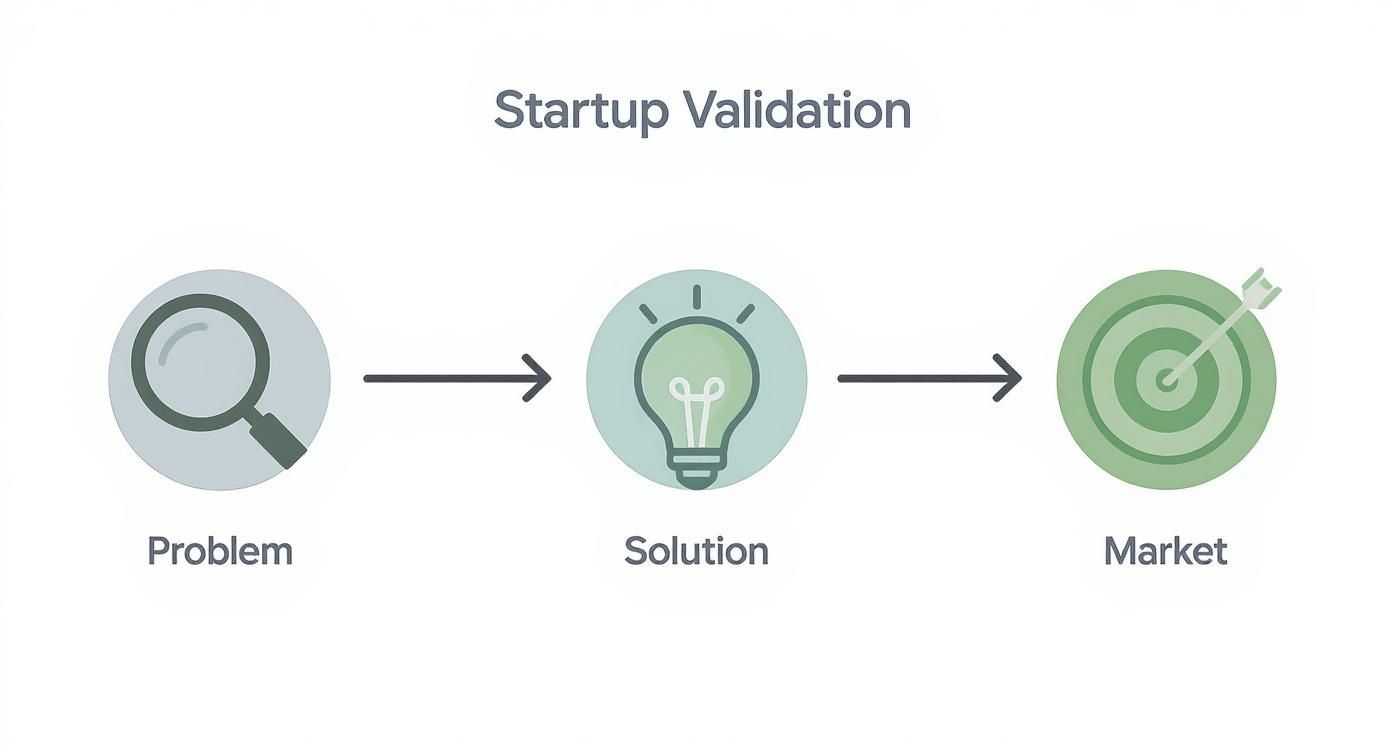
The flow is intentional. A brilliant solution is completely worthless if it isn’t tied to a validated problem and a customer base you can actually reach.
The Real Cost of Skipping This Step
Founders are passionate. It’s our greatest strength and our biggest blind spot. We fall head over heels for our own ideas, getting trapped in the “if I build it, they will come” fantasy.
This thinking leads directly to wasted months and drained bank accounts. Validation forces you to confront uncomfortable truths early on, which is infinitely better than facing them after you’ve already launched.
The benefits are crystal clear:
-
You save money. You avoid burning through cash on engineering for a product nobody ends up buying.
-
You save time. You quickly figure out what doesn’t work, letting you pivot or scrap an idea without months of wasted effort.
-
You build a better product. Early customer feedback is an absolute goldmine for shaping a solution that solves a real, painful problem.
The goal of validation isn’t to get a ‘yes’ or ‘no’ answer. It’s to learn. Every conversation, every test, and every piece of feedback is a clue that gets you closer to product-market fit.
A Framework for Finding Certainty
This guide is an actionable playbook for navigating the validation process. We’re moving beyond theory to give you a step-by-step framework to test your assumptions, from writing your first hypothesis to running low-cost experiments.
To give you a bird’s-eye view, here’s a quick look at the journey we’re about to take.
The Startup Validation Playbook At a Glance
| Validation Stage | Primary Goal | Key Activities |
|---|---|---|
| Stage 1: Hypothesis | Define your core assumptions about the problem, customer, and solution. | Crafting a clear hypothesis, defining your Ideal Customer Profile (ICP). |
| Stage 2: Qualitative Testing | Get direct feedback from your target audience to understand their pain points. | Conducting customer interviews, running user surveys, synthesizing feedback. |
| Stage 3: Quantitative Testing | Measure real-world interest and demand with low-effort experiments. | Building landing pages, running targeted ads, creating waitlists, pre-selling. |
| Stage 4: Lightweight MVP | Build the simplest possible version of your solution to test value delivery. | Exploring concierge MVPs, no-code builds, or an early SaaS stack. |
| Stage 5: Go/No-Go Decision | Use the evidence you’ve gathered to make an informed decision. | Defining success metrics, analyzing results, deciding on next steps. |
This structured approach is all about gathering real-world evidence. By following this framework, you’ll sidestep the common pitfalls and dramatically increase your odds of building something people actually want—and are more than happy to pay for.
Defining Your Core Assumptions and Ideal Customer
Before you write a single line of code, you need to get brutally honest about what you’re assuming. Every startup idea is really just a bundle of guesses—guesses about a problem, a customer, and a solution. Your first job is to unpack those guesses and hold them up to the light.
This isn’t an exercise in being right. It’s about finding the biggest leaps of faith in your model. Get one of these core beliefs wrong, and the entire business can crumble.

Mapping Your Riskiest Assumptions
A simple assumption map is the perfect place to start. Forget the complex business plan for now; this is a quick-and-dirty way to separate what you think you know from what you actually know. It forces you to put words to the foundational beliefs that have to be true for your startup to have a chance.
Let’s say your idea is a project management tool for remote freelance designers. Your assumptions might look something like this:
-
Problem Assumption: Designers are constantly losing track of client feedback spread across email, Slack, and Figma.
-
Solution Assumption: They would see immediate value in a single platform that consolidates all that feedback, saving them time and preventing mistakes.
-
Customer Assumption: Freelance designers are actively hunting for a tool like this and are willing to pay a monthly subscription for it.
Each of these is a hypothesis, just a guess waiting for proof. The trick is to figure out which one is the riskiest. Spoiler: it’s rarely about your solution. It’s almost always about the severity of the problem or someone’s willingness to open their wallet.
Your most dangerous assumption is the one that, if it turns out to be false, makes everything else you’re doing completely pointless. Test that one first.
Ditching Vague Demographics for a Sharp ICP
Okay, now let’s talk about who you’re building this for. “Small businesses” isn’t a customer segment. “Marketers” isn’t a target audience. They’re just massive, undefined crowds. If you try to validate your idea with everyone, your feedback will be a noisy, contradictory mess.
You need a razor-sharp Ideal Customer Profile (ICP). This goes way beyond basic demographics. It’s a detailed sketch of the specific person who feels the pain you’re solving most acutely. Think of it like creating a character profile for your first true fan.
Building Your Ideal Customer Profile
Forget broad categories. The real magic is in the details—specific behaviors, job titles, and the context of their daily work. This level of clarity will be your compass for the entire validation journey.
Here’s how you can turn a vague target into a potent ICP:
| Vague Target | Sharp ICP |
|---|---|
| ”Small Businesses" | "Lead technicians at HVAC companies with 5-10 employees who personally struggle with disorganized parts inventory." |
| "Content Marketers" | "Content marketing managers at B2B SaaS companies (Series A to C) responsible for case studies who find the internal approval process slow and manual." |
| "Remote Workers" | "Junior software developers working remotely for the first time who feel disconnected from their team and are missing mentorship opportunities.” |
See the difference? We’re not just defining a person; we’re zeroing in on their specific context and problem. The HVAC tech isn’t just any technician; he’s the one in a specific-sized company wrestling with inventory. This focus makes it a thousand times easier to actually find these people for interviews and tests.
By nailing down your riskiest assumptions and crafting a precise ICP, you’ve built a solid foundation. You know exactly what you need to prove and who you need to talk to. This transforms the huge, abstract challenge of “validating an idea” into a series of small, manageable, targeted steps.
Uncovering Real Problems with Customer Discovery Interviews
Alright, it’s time to step away from the keyboard and do something that feels unnatural to a lot of founders: talk to people. This is where you find out if you’re building something people actually need or just a cool solution to a problem nobody has.
This isn’t about pitching your idea. In fact, you should avoid that at all costs. Customer discovery is about deep listening. It’s your chance to hear the unfiltered truth about your target audience’s daily frustrations, workflows, and pain points. Get this right, and you’ll know whether you’re on the right track or need to pivot—before you burn a single dollar on development.
The goal isn’t to ask, “So, would you buy my amazing product?” That just invites polite lies. You need a framework to uncover their past behaviors and current challenges.
The Art of Not Pitching
Your gut instinct will scream at you to talk about your idea. You’re excited, and you want them to be, too. Fight that urge. The moment you start explaining your solution, the conversation dies.
Your counterpart stops being an expert on their own problems and becomes a critic of your idea. You’ll get compliments, feature requests, and vague encouragement—not honest insights. This is the heart of The Mom Test by Rob Fitzpatrick: keep the conversation focused entirely on their life, not your idea.
Good questions are about specific, past experiences:
-
“Walk me through the last time you had to manage [the specific task].”
-
“What was the most frustrating part of that?”
-
“Have you tried to solve this before? What did you try?”
-
“What do you do now if you don’t have a solution for that?”
These kinds of questions ground the conversation in reality. They force people to recall actual events, not just speculate about a hypothetical future with your product.
Finding and Recruiting the Right People
So, where do you find these people? Don’t just blast out generic messages. Your goal is to go where your Ideal Customer Profile already hangs out and talks about their work.
Start digging into niche online communities:
-
Subreddits: Look for communities related to their profession or industry (like r/sysadmin for IT pros or r/freelancewriters for, well, freelance writers).
-
LinkedIn Groups: Search for groups dedicated to specific job titles or fields.
-
Slack & Discord Communities: Many industries have private communities for networking. Find them, join, and listen to the conversations.
When you reach out, keep it brief and personal. Frame it as research, not a sales pitch. Something like this works wonders: “Hi [Name], I saw your comment in [Group Name] about [a specific topic]. I’m doing some research on how [job title] handle [the problem] and would love to learn from your experience. Do you have 15 minutes for a quick chat next week?”
Turning Conversations into Actionable Insights
After 10-15 good conversations, you’ll be swimming in notes. This is where many founders get stuck. The secret is to look for patterns, not just one-off comments. Affinity mapping is a simple but surprisingly effective way to make sense of the chaos.
-
Pull Out Key Quotes: Go through your notes and pull out specific pain points, emotional phrases, and interesting observations. Put each one on a separate virtual sticky note.
-
Group Similar Ideas: Start clustering the notes into themes. You’ll quickly see recurring topics emerge, like “frustration with manual data entry” or “difficulty collaborating with other teams.”
-
Name Your Clusters: Give each group a descriptive title. These become the core problems your target audience consistently brings up.
If you hear multiple people describe the same specific, frustrating workaround they’ve built for themselves—like a ridiculously complex spreadsheet—you’ve likely struck gold. That’s a massive signal of an urgent, unsolved problem.
This process transforms a pile of anecdotes into a clear map of shared pains. The insights you gather here are pure gold, and using dedicated customer interview research tools can help you organize and analyze your findings without losing your mind. A 2025 study actually highlighted that about 70% of startups that did this kind of validation saw a higher chance of success. Discover more insights for startup idea validation. If you’ve found a real problem worth solving, you now have the direct quotes and real-world evidence to prove it.
Gauging Market Interest with Low-Cost Experiments
Positive conversations are fantastic, but they don’t pay the bills. The real test comes when you ask for a commitment—not just a compliment. This is where we shift gears from gathering rich, qualitative insights to collecting hard, quantitative data that proves people actually want what you’re building.
It’s time to move from “would you” to “will you.” The goal is to run cheap, simple experiments that measure what people do, not just what they say. This is how you find out if they’re willing to give you their email, their time, or—the ultimate validation—their money.
Crafting a Simple Yet Powerful Landing Page
Your first quantitative test should be a dead-simple landing page. Forget about building a complex website. Using tools like Carrd or Webflow, you can spin up a single, focused page in an afternoon. This isn’t a product showcase; it’s a sales pitch for a specific outcome.
Your landing page must do three things exceptionally well:
-
Nail the Headline: It should echo the exact pain points you heard over and over in your interviews. Speak their language, not yours.
-
Sell the Transformation: Don’t list features. Nobody cares about features yet. Describe how your solution will make their life better, save them time, or kill a major frustration.
-
Have a Single, Clear Call to Action (CTA): This is critical. Ask for one thing. The easiest ask at this stage? “Join the waitlist.”
A waitlist is more than just an email list; it’s a direct measure of intent. For a highly targeted B2B niche, a waitlist conversion rate of 5-10% is a strong signal you’re onto something. For a broader B2C idea, 2-5% might be more realistic, but it all depends on where your traffic is coming from.
A landing page forces you to distill your value proposition down to its absolute essence. If you can’t convince someone to give you their email in exchange for a solution to their problem, you’ll have a much harder time convincing them to pay for it.
Driving Targeted Traffic with a Small Ad Budget
Once your page is live, you need to get the right eyeballs on it. A small, strategic ad campaign is perfect for this. Platforms like LinkedIn, Facebook, or even Reddit let you target users with incredible precision, matching the Ideal Customer Profile you already built.
Set a modest budget—think $100 to $200. Your goal isn’t to get thousands of sign-ups; it’s to get statistically relevant data. You’re really testing two things: the appeal of your value prop and whether you can even reach your target audience cost-effectively.
This is a classic “smoke test.” You’re selling the promise of a solution to see who bites. The data you get back—cost per click, conversion rate, and cost per waitlist sign-up—is an early, real-world indicator of your potential customer acquisition cost. It grounds your entire business model in reality.
Moving Beyond the Waitlist to Test Commitment
While a waitlist is a great start, you can run other lean experiments to get an even stronger signal. These tests gradually escalate the level of commitment you ask for, giving you more and more certainty about demand.
Here are a few powerful validation tactics I’ve used:
-
The Feature “Smoke Test”: On your landing page, add a button or link for a key feature that doesn’t exist yet. When someone clicks it, show a simple message: “Thanks for your interest! We’re still working on this, but you’ll be the first to know when it’s ready.” That click-through rate is pure, unfiltered data on feature demand.
-
The Pre-Order Page: This is the ultimate test of willingness to pay. Set up a page allowing users to pre-order your product, usually at a steep discount. Be totally transparent that it’s not built yet and offer a no-questions-asked money-back guarantee. It’s shocking that only 9% of founders use pre-sales for validation, because it’s the strongest signal you can possibly get. If people pull out their credit cards, you’ve found a real, painful problem.
Managing these early sign-ups and keeping them warm is absolutely critical. You can learn more about the best waitlist launch campaign tools to keep your potential first customers engaged and informed.
By combining these low-cost experiments, you start building a compelling, data-backed case for whether your idea has legs—long before you write a single line of code.
Testing Your Solution with the Right Kind of MVP
Alright, you’ve done the interviews, the landing page test is showing promise, and you’ve got some positive signals. Now for the real test: can your solution actually deliver value? This is where the Minimum Viable Product (MVP) comes in, but let’s be crystal clear about what that means.
An MVP isn’t a buggy, feature-incomplete version of your final product. It’s the fastest, cheapest way to test your core value proposition with real, paying customers. Forget about building something scalable or beautiful for now. The goal is to create the simplest possible experience that solves one specific, painful problem for your ideal customer.
So many founders fall into the trap of over-engineering their MVP, sinking months and thousands of dollars into features that nobody asked for. The truth? You can often build an incredibly effective MVP without writing a single line of code.

Embrace Manual-First MVPs
Before you even think about software, ask yourself how you could deliver the promised value by hand. This manual-first approach forces you into the trenches with your first customers, giving you an unparalleled, ground-level view of their workflow. It’s the ultimate way to learn before you build.
Two battle-tested manual MVP types stand out:
-
Concierge MVP: You are the product. You deliver the entire service manually. Let’s say you’re building an AI tool that creates social media calendars. With a Concierge MVP, you’d onboard a few clients, personally research their topics, write the posts, design the graphics, and deliver a finished calendar in a Google Doc. You charge for this service, validating their willingness to pay while learning every single frustrating nuance of the problem you’re trying to solve.
-
Wizard of Oz MVP: This one’s a bit sneaky. It presents a simple front-end—like a basic form or a dashboard—that looks automated to the user. Behind the curtain, however, it’s you and your team pulling all the levers. A user might submit a request through a website, thinking an algorithm is processing it, but you’re actually doing the work manually and emailing them the result. This tests user behavior and the perceived value of your “automated” solution without the heavy engineering lift.
The beauty of a manual MVP is that you’re forced to get incredibly close to your first users. The friction you feel personally is a roadmap for what your software eventually needs to automate.
Building Functional Prototypes with No-Code Tools
Once you’re ready for a more interactive experience, no-code platforms are your best friend. They’ve become incredibly powerful.
Tools like Bubble or Glide let you build surprisingly complex web and mobile apps using visual, drag-and-drop interfaces. You can then stitch them together with other services using automation platforms like Zapier to create a functional, interactive prototype.
For example, you could build a simple marketplace where users submit listings via a Tally form. That form submission could trigger a Zapier automation that adds the data to an Airtable base, which is then displayed on a clean front-end website built with Softr. You can literally get this entire flow running over a weekend to start testing core user interactions.
The True Purpose of an MVP
Let’s not forget the main point here. The primary goal of any MVP—whether it’s a high-touch concierge service or a slick no-code app—is to test your most critical assumption: will people actually pay for this?
Charging from day one is the strongest validation signal you can possibly get. If users aren’t willing to part with a small amount of money for the value you deliver manually, they sure aren’t going to pay more for a polished software version later.
This stage is all about learning what users really want, not what they say they want. For a deeper dive, our guide on how to develop a SaaS MVP users actually want offers more specific strategies. By keeping your MVP lean and focused on learning, you validate your idea with real-world usage and payment data—the only evidence that matters before you invest in full-scale development.
Making the Final Go, Pivot, or Stop Decision
You’ve done the work. You’ve got notebooks filled with customer interview notes, conversion data humming from your landing page, and maybe even some raw feedback from your first MVP users. Now comes the moment of truth—the decision that separates successful founders from those who chase a failing idea into the ground.
This isn’t about blind passion or gut feelings anymore. It’s about staring at the cold, hard evidence you’ve collected and making a rational choice. This is where you decide whether to hit the gas, change direction, or have the courage to pull the plug.
Define Your Success Metrics Before You Start
Before you even glance at the results, you need to know what “good” looks like. Seriously, this is the most important part. Setting your go/no-go criteria before you run a single test is the best defense against confirmation bias. It stops you from moving the goalposts just because you’ve fallen in love with your own idea.
These metrics can’t be fluffy. Vague goals like “get some interest” are useless. You need specific, measurable targets. For instance, your pre-defined success might look like this:
-
Quantitative Goal: Hit a 5% or higher conversion rate on the waitlist landing page from our targeted ad campaign.
-
Qualitative Goal: See at least 7 out of 10 MVP users come back and use the solution a second time without any nagging from us.
-
Financial Goal: Get 10 people to actually pull out their credit cards and pre-order at a discount within the first 30 days.
Having these benchmarks removes the emotion. You either hit the numbers, or you didn’t. There’s no room for debate, which is exactly what you need for an honest look at your idea.
Reading the Signals: Go, Pivot, or Stop
With your metrics in hand, it’s time to see where you landed. Your results will almost always point you toward one of three paths. Each one requires a different, decisive action.
Go (Green Light)
You crushed it. You met or blew past your predefined metrics. The quantitative data is strong (maybe you hit a 12% conversion rate), and the qualitative feedback is even better. Your early users aren’t just being nice; they’re asking when they can pay for the real thing. This is your green light to start building a more robust product.
Pivot (Yellow Light)
The results are… interesting. Maybe your landing page converted like crazy, but the MVP users couldn’t figure out the main workflow. Or perhaps your interviews revealed a much bigger, more painful problem than the one you thought you were solving. This isn’t a failure—it’s a critical clue. A pivot means you’re changing a core piece of your strategy (like the target customer, the problem, or the solution itself) and running a new validation experiment.
Stop (Red Light)
This is the toughest one to face, but it’s also the most valuable signal. You missed your metrics, and not by a little. The waitlist is a ghost town, and your MVP users vanished after one login. The market is telling you something loud and clear: they just don’t care enough about this problem.
Having the discipline to stop working on a validated bad idea is a founder’s superpower. It frees up your time, energy, and capital to go find a problem that actually matters. Don’t see it as failure. See it as a successful experiment that just saved you years of wasted effort.
Got Questions About Idea Validation?
You’re not alone. When you’re in the trenches trying to figure out if your idea has legs, a lot of questions come up. Here are the most common ones I hear from founders, with some straight-to-the-point answers.
How Much Should I Spend on Validation?
Validation should be cheap. Seriously. The whole point is to learn as much as you can while spending as little as possible.
A great starting point is a $100-$300 budget for some targeted ads. Use that to drive traffic to a simple landing page and see if people are interested enough to click. Outside of that, your biggest investment is your own time—specifically, the time you spend talking to potential customers.
How Many People Do I Need to Interview?
Forget statistical significance. You’re hunting for patterns.
You’ll find that after 10-15 really good conversations with people who fit your Ideal Customer Profile, you’ll start hearing the same pains, problems, and phrases over and over again. That’s your cue. It means you’ve likely found a core problem and have enough qualitative insight to decide on your next move.
It’s not about hitting a magic number of interviews; it’s about the quality of the insights. When you can pretty much predict what the next person is going to say about their biggest frustrations, you’re done.
What if I Get Negative Feedback?
Negative feedback isn’t a failure—it’s a gift. It’s the data that stops you from wasting a year of your life building something nobody actually wants.
Don’t just dismiss it. Dig in. Ask “why?” until you get to the root of their objection. This is the feedback that helps you either pivot to a much better idea or confidently walk away to find a real problem worth solving.
Ready to move from idea to a secure, production-grade MVP without wrestling with DevOps? saasbrella gives you the complete, AI-ready foundation to launch your SaaS application in minutes, not months. Start your 14-day free trial and focus on building your product, not your infrastructure.
Ready to build?
Get Started for Free. Build on a production-ready foundation with authentication, database, and deployment already configured.
No credit card required. Cancel anytime.