How to Develop a SaaS MVP Users Actually Want
Before you write a single line of code, you need a blueprint. This isn’t the exciting part, I know, but skipping this step is the single most common—and costly—mistake founders make.
This early strategic work is what separates a viable business from just another side project. Think of it like drawing the architectural plans for a house. You wouldn’t start nailing boards together without knowing who will live there, what rooms they need, and how the plumbing will work. Your SaaS MVP is no different.
Building Your Strategic Blueprint Before You Code
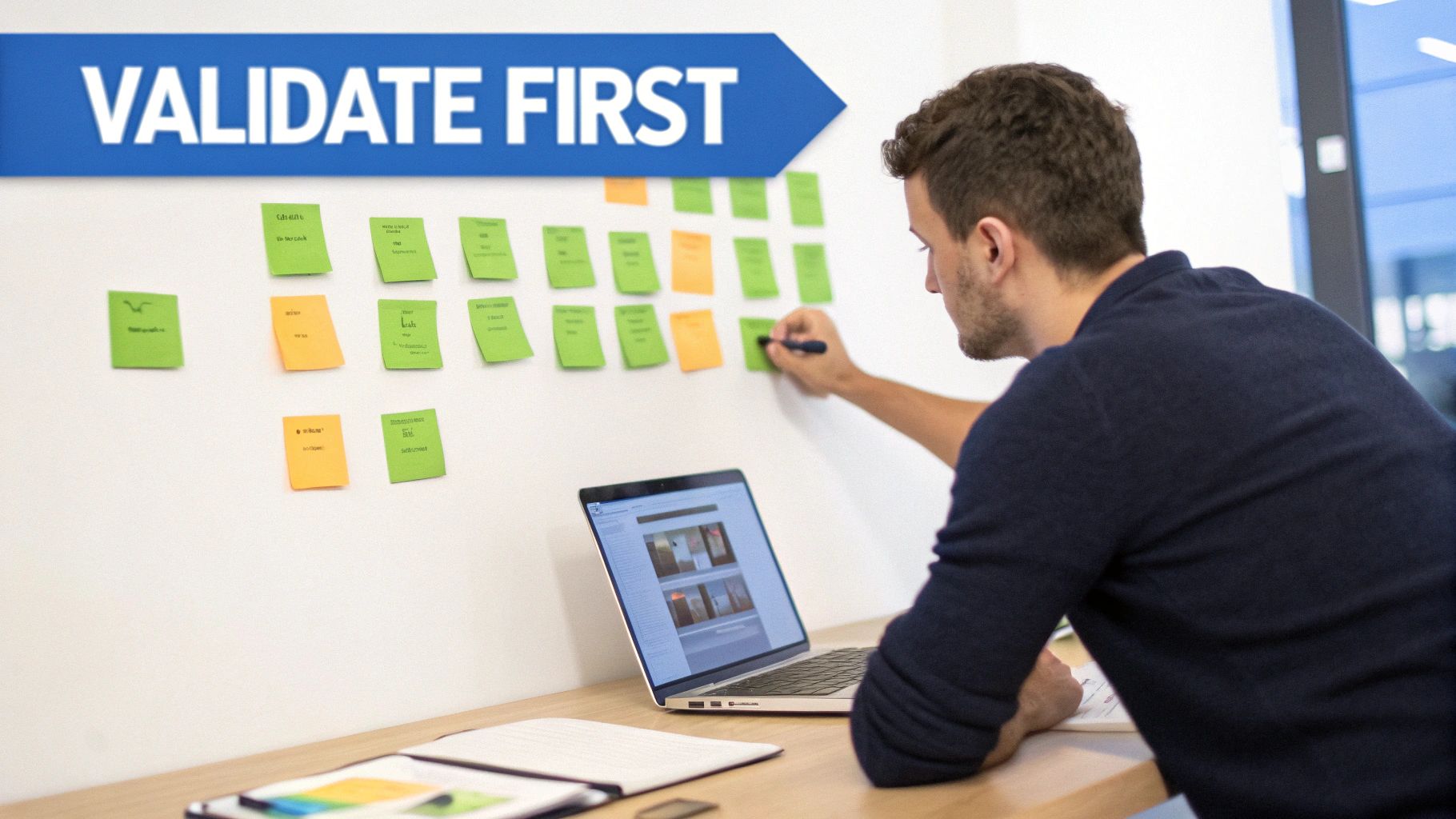
The pull to start building is strong, but the real fate of your MVP is decided long before your fingers hit the keyboard. This is where you lay the foundation.
Validate Your Idea with Real Conversations
First things first: you have to confirm that the problem you think exists is a real, painful, and urgent issue for a specific group of people. Surveys and market research reports are fine, but they often hide the truth behind averages.
The gold standard is getting on the phone (or a Zoom call) and having direct conversations. These aren’t sales pitches; they are fact-finding missions. Your only goal is to listen. To get the most out of these chats, it’s smart to use dedicated customer interview research tools to structure your questions and spot patterns in the feedback.
Try asking open-ended questions that get people talking:
- “Can you walk me through how you currently handle [the problem]?”
- “What’s the most frustrating part of that whole process for you?”
- “Have you tried to solve this before? What happened when you did?”
- “If you could wave a magic wand and fix one thing about this, what would it be?”
Listen for emotion—frustration, annoyance, even desperation. That’s where the opportunity is. If you can’t find anyone willing to talk about the problem, or if they just shrug it off as a minor inconvenience, that’s a major red flag. It might be time to rethink the whole idea.
Define Your Core Feature Set
An MVP is minimal by definition. It’s not about cramming in every cool feature you’ve dreamed up. It’s about building the smallest possible product that solves the core problem and delivers real value. Anything else is a distraction.
Building a SaaS MVP is the go-to strategy for a reason—it lets you test the waters with minimal risk. But “minimal” doesn’t always mean cheap. Industry benchmarks show the cost to build a SaaS MVP can range from $10,000 to over $100,000, depending on what you’re building. A basic product with just user login, a simple dashboard, and one payment integration can easily cost $10,000 to $30,000. That financial reality makes a tightly scoped feature set non-negotiable.
To keep your scope in check, you need a system. A simple framework is to categorize every potential feature by the impact it will have on the user versus how much effort it will take to build. Your MVP should only include the high-impact, low-to-medium effort features.
This is a great way to visualize your priorities and push back against the temptation of ‘feature creep’—that sneaky tendency to add just one more thing.
Core MVP Feature Scoping Framework
| Priority Level | Feature Category | Description | Example |
|---|---|---|---|
| P1: Must-Have | High Impact, Low Effort | Absolutely essential for solving the core user problem. Without this, the product is useless. | For a project management tool: the ability to create a task and assign it to someone. |
| P2: Should-Have | High Impact, High Effort | Important features that deliver significant value but require more complex development. | For the same tool: a collaborative real-time editor for task descriptions. |
| P3: Nice-to-Have | Low Impact, Low Effort | Small improvements or quality-of-life features that aren’t critical for launch. | Adding custom color themes to the user interface. |
| P4: Don’t Build | Low Impact, High Effort | Complex features that solve edge cases or provide minimal value to the core user. | Building a native mobile app for the MVP launch. |
Using a simple table like this forces you to be honest about what’s truly essential. Your MVP should be almost entirely P1 features, with maybe one or two carefully chosen P2s if they are absolutely critical to your value proposition.
Set Clear Success Metrics from Day One
How will you actually know if your MVP is working? “Getting users” is a goal, not a metric. You need specific, measurable Key Performance Indicators (KPIs) defined before you launch. This gives you a clear definition of what success looks like and helps you make data-driven decisions instead of guessing.
Start with these four fundamental metrics:
- Activation Rate: The percentage of new signups who complete a key first action (like creating their first project or inviting a teammate). This proves they “get” the value.
- Feature Adoption Rate: Of your active users, what percentage are actually using your main, core feature?
- User Retention: What percentage of users come back after their first day, week, or month? This is the ultimate test of value.
- Willingness to Pay: How many users convert to a paid plan or tell you they would if it were available?
Tracking these numbers turns your MVP from a simple product launch into a strategic business experiment. You’re not just releasing code; you’re testing a hypothesis.
Choosing a Smart Tech Stack for Speed and Scale
Picking the tech for your MVP is a big deal, but it shouldn’t be a source of analysis paralysis. Your goal isn’t to choose the “perfect” stack for the next decade. It’s to pick the most practical, efficient stack that gets you to market fast while leaving the door open for future growth. Right now, it’s all about speed, cost, and what your team already knows.
This is a balancing act. You need tech that lets you build quickly without painting yourself into a corner. I’ve seen too many founders over-engineer with a complex microservices setup for a product with zero users—a classic way to burn through cash and time. On the flip side, choosing an obscure framework can turn into a hiring and maintenance nightmare later on.
Monolith vs. Microservices: A Pragmatic View
The first fork in the road is usually monolith vs. microservices. Let’s break it down.
A monolithic architecture is a single, unified codebase where everything is interconnected. For early-stage products, this is almost always faster to build because everything lives in one place, making local development and deployment dead simple.
A microservices architecture splits the application into smaller, independent services that talk to each other. This can be great for long-term scalability and letting separate teams work in parallel without stepping on each other’s toes.
For an MVP? A well-structured monolith is your best friend. It’s simpler, faster to get off the ground, and avoids the headache of managing a dozen different deployed services. You can always strategically break off pieces into microservices later as your product and team grow.
Selecting the Right Frameworks and Languages
With that architectural choice made, it’s time to pick your core language and framework. The best answer is almost always the one your team already knows inside and out. Developer productivity is your most valuable currency when you’re building an MVP.
Here are some popular, reliable choices for SaaS development:
- Node.js (with Express or NestJS): Fantastic for real-time apps and known for its raw speed. The massive JavaScript ecosystem means there’s a library for just about anything you can imagine.
- Python (with Django or Flask): A no-brainer if your SaaS crunches data, uses machine learning, or has any AI components. Django’s “batteries-included” philosophy can seriously speed things up.
- Ruby on Rails: Famous for its “convention over configuration” approach that helps developers ship features incredibly fast. It’s still a rock-solid choice for rapid MVP development.
The key takeaway here is to fight the urge to chase the latest, hottest tech. “Shiny object syndrome” is a real productivity killer. Pick a proven, well-supported framework that lets your team hit the ground running. Your MVP will be judged on the problem it solves, not the novelty of its tech stack.
The Undeniable Advantage of Cloud Platforms
Gone are the days of buying and managing your own servers. Cloud platforms are the default for a reason—they handle the messy infrastructure so you can focus on writing code. The most successful SaaS MVPs are built on cloud-native architectures that slash time-to-market. In fact, industry data shows cloud-based MVPs can cut infrastructure setup time by 40–60% compared to old-school on-premise solutions. You can find more on these trends from MVP development industry experts.
The big players offer everything you need for an MVP:
- AWS (Amazon Web Services): The market leader with the most extensive toolbox.
- Google Cloud Platform (GCP): Known for its strengths in data analytics and Kubernetes.
- Microsoft Azure: A powerful option, especially if your team is already in the Microsoft ecosystem.
Starting with a cloud provider lets you deploy a scalable, secure, and cost-effective app without a huge upfront investment in hardware.
Accelerate Development with a SaaS Boilerplate
Even with the right framework and cloud provider, you’re still on the hook for building common features that don’t add any unique value to your product. Think user authentication, billing integration, team management, and email notifications. This is repetitive, undifferentiated work.
This is where a prebuilt foundation becomes a game-changer.
Instead of reinventing the wheel, a high-quality SaaS starter kit handles all of this foundational work for you. It gives you a deployed, secure, and maintainable stack with all the core infrastructure already configured. You get features like Stripe subscriptions, user roles, file uploads, and OAuth right out of the box.
Using a prebuilt foundation like this lets your team skip weeks—or even months—of setup and focus 100% of its energy on building the features that actually solve your customers’ problems. It’s one of the single most effective shortcuts on the path from idea to a production-ready SaaS MVP.
Executing an Agile Development Roadmap
Alright, you’ve done the hard work of validating your idea and picking a tech stack. Now it’s time to actually build the thing. This is where the rubber meets the road—translating all those plans and user insights into a real, functional product.
To avoid getting bogged down, we’ll lean heavily on an agile development approach. Forget massive, six-month project plans. Agile breaks the monumental task of “building a product” into small, manageable chunks called sprints. This rhythm of building, testing, and getting feedback ensures you’re always working on what matters most and can pivot quickly when you need to.
Setting Up a Solid Development Foundation
Before a single feature gets built, you need a professional, automated environment. A messy setup is a recipe for disaster—it leads to bugs, slow progress, and frustrated developers. Your very first milestone should be establishing a clean workflow.
This isn’t optional. Get these pieces in place from day one:
- Version Control: Use Git. This is non-negotiable for tracking changes, collaborating, and having the ability to roll back mistakes without a panic attack.
- Local Development Environment: Every developer must be able to run the entire application on their own machine with a single command. Tools like Docker Compose are perfect for this, eliminating the classic “it works on my machine” headache.
- CI/CD Pipeline: Continuous Integration/Continuous Deployment is your secret weapon. This pipeline automatically runs tests and deploys your code whenever you push changes, cutting down on manual errors and making releases boringly predictable.
Nailing this foundation will save you countless hours of frustration. It’s the difference between a smooth development process and a chaotic one.
Structuring Your First Development Sprints
Your roadmap should be broken down into short, focused sprints, usually lasting one to two weeks. Each sprint needs a clear, achievable goal. Don’t try to boil the ocean.
Here’s a practical sequence for your initial sprints:
- Sprint 0 (Setup): This one is all about the plumbing. Set up your CI/CD pipeline, configure your cloud environment, and deploy a dead-simple “Hello, World!” app. The goal isn’t to build a feature, but to prove your entire deployment process works end-to-end.
- Sprint 1 (Authentication & Core Data Model): Time to build the backbone. Implement user sign-up, login, and password reset. Define the core data structures in your database (e.g., users, projects, tasks). This is the scaffolding for everything else.
- Sprint 2 (The Core Feature): Now for the fun part. Tackle the single most critical feature from your P1 list. Build the absolute minimum version that solves the user’s main problem. If you’re building a project management tool, this might just be creating and viewing a list of tasks. That’s it.
The point of each sprint is to deliver a small, vertical slice of working software. Don’t try to build everything at once. This approach builds momentum and lets you get feedback on real, functioning code as early as possible.
This infographic captures the spirit of how you should be thinking during development—balancing the need for speed with the reality of building something that can grow.
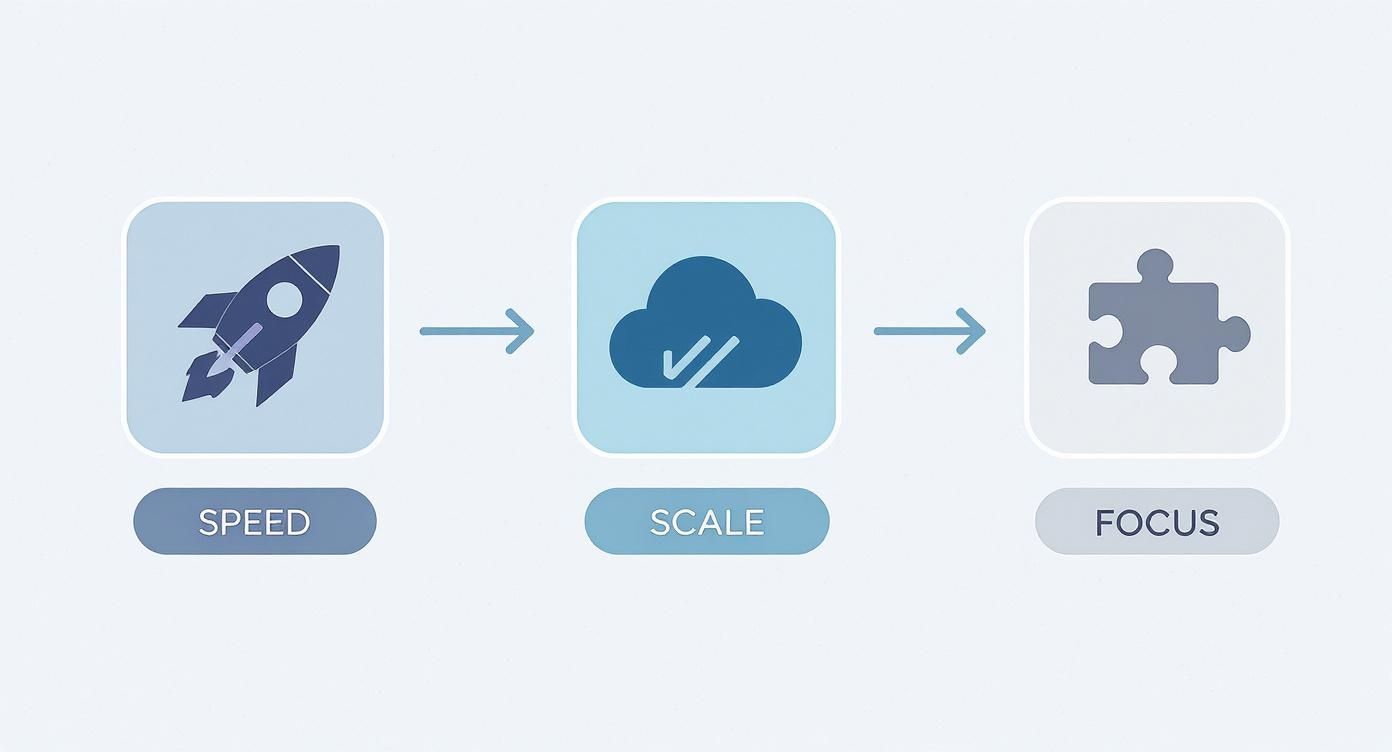
It’s all about moving fast to get to market, planning for scale so you don’t paint yourself into a corner, and staying relentlessly focused on your unique value.
Integrating Security and Testing from the Start
Security is not a feature you bolt on later. It has to be baked in from the very first line of code. The same goes for automated testing—it’s the only sane way to add new features without constantly breaking old ones.
Make these practices a non-negotiable part of every sprint:
- Data Encryption: All sensitive user data must be encrypted both in transit (with SSL/TLS) and at rest (in the database). No exceptions.
- Access Control: Implement clear, role-based permissions from the jump. A user should only ever be able to see or touch their own data unless you explicitly grant them more access.
- Automated Testing: For every feature you build, write tests to prove it works. This means unit tests for small functions, integration tests to see how components interact, and end-to-end tests that mimic a real user’s journey. It feels slow at first, but a solid test suite dramatically increases your development speed down the road.
The Pre-Launch Readiness Checklist
As you near the end of the initial build, it’s time for one final, honest quality check. Before you invite a single user, run through a pre-launch checklist to make sure your app is stable and secure enough for the real world.
This isn’t about chasing perfection. Your MVP will have bugs. But it shouldn’t crash every five minutes or leak customer data.
Your final checklist should cover these bases:
- Performance Testing: Simulate a realistic number of users to see if anything breaks or slows to a crawl. Fix the most obvious bottlenecks.
- Cross-Browser Testing: Make sure the app works reasonably well on the latest versions of Chrome, Firefox, and Safari.
- Security Audit: Do a quick review for common vulnerabilities like SQL injection or cross-site scripting (XSS).
- Final Bug Bash: Get the whole team—and maybe a few trusted friends—to try their absolute hardest to break the application. Log every issue you find.
Ticking off these boxes gives you the confidence that you’re launching a professional, production-ready SaaS MVP, not just a fragile prototype.
Crafting Your Go-To-Market and Launch Plan

Having a functional, production-ready SaaS MVP is a massive achievement. But honestly, it’s only half the battle. A brilliant product nobody knows about is just a well-engineered secret.
Your go-to-market (GTM) plan is how you turn all that code into real-world momentum, user feedback, and—most importantly—your first paying customers. This isn’t about renting a billboard in Times Square. An MVP launch is a controlled, strategic exercise to get your product into the hands of the right people.
The goal here is learning, not mass-market domination.
Setting Your Initial Pricing
Pricing an MVP feels like a shot in the dark, but it doesn’t have to be. Your goal is twofold: validate that people are willing to pay something for your solution and encourage early adoption.
Forget about complex, multi-tiered pricing pages. They just create confusion at this stage.
Keep it dead simple. Often, a single, affordable plan is all you need. You could offer a significant discount for the first 25 or 50 beta users to create urgency and reward them for their faith. This approach gives you a concrete data point: you can definitively say, “X number of people were willing to pay $Y for this.”
Your initial price is a hypothesis, not a final decision. It’s a starting point for a conversation with the market. Getting it ‘perfect’ is impossible; getting it ‘good enough’ to attract your first users is all that matters right now.
Remember, you can—and absolutely should—change your pricing later as you add more value. Don’t let pricing paralysis delay your launch.
Building Your Launchpad: The Landing Page
Your landing page is your digital storefront. Before you even think about driving traffic, you need a clear, compelling destination that converts visitors into signups.
This page has one job: convince your ideal customer that your MVP is the solution to their specific, painful problem.
A high-converting MVP landing page only needs a few key elements:
- A Killer Headline: Immediately state the primary benefit and target audience. Think “Effortless Time Tracking for Freelance Designers.”
- A Clear Call-to-Action (CTA): Use a prominent button with actionable text like “Start My 14-Day Trial” or “Get Early Access.”
- Benefit-Oriented Copy: Don’t list features. Explain how those features solve the user’s problem and make their life better.
- Simple ‘Above the Fold’ Design: The most critical info should be visible without scrolling. A visitor should instantly get what you do and who you do it for.
Your landing page isn’t just a marketing tool; it’s the beginning of the product experience. It sets the first impression and frames the value before a user ever clicks “sign up.”
Finding and Engaging Your First Users
With your pricing and landing page ready, it’s time to find your tribe. A mass marketing blast is a complete waste of time and money at this stage. For a SaaS MVP, you need to go where your target audience already congregates and engage them directly.
This is a manual, hands-on process.
Forget about SEO or paid ads for now. Focus on low-cost, high-impact channels where you can have real conversations:
- Niche Online Communities: Find the subreddits, Slack groups, Discord servers, or forums where your ideal customers hang out. Don’t just drop a link and run. Become a helpful member first, answer questions, and then present your MVP as a solution when the context is right.
- Direct Outreach: Go back to the list of people you interviewed during validation. They’re your warmest leads. Offer them free access or a steep discount for being part of your initial user group.
- Targeted Content: Write a few high-quality blog posts that directly address the pain point your SaaS solves. Share this content in the communities you’ve joined to build authority and attract interested users.
This surgical approach ensures the feedback you get is from the right people. Your mission is simple: find those first ten users who truly love what you’ve built.
Mastering Post-Launch Metrics and Iteration
Your MVP launch isn’t the finish line; it’s the starting gun. This is the moment your beautifully crafted hypotheses crash into the messy reality of real users. The real work of building a sustainable business starts now.
Once people are actually clicking around in your product, you have an incredible opportunity to learn. This post-launch phase is all about a continuous loop: measure, learn, and iterate. This cycle is what will eventually transform a basic MVP into a product that customers can’t imagine living without.
Setting Up Your Data Dashboard
You can’t improve what you don’t measure. Guesswork is the enemy of progress, especially in the early days. Your first job after launching is to get a simple dashboard running to track the key performance indicators (KPIs) that actually matter for a new SaaS.
Forget vanity metrics like total signups. We need to understand user behavior. Where are people finding value? Where are they getting stuck and giving up?
From day one, keep a close eye on these essentials:
- User Activation Rate: What percentage of new users actually complete that key “Aha!” moment? For a project management tool, this might be creating their first task list. This tells you if people “get” your product’s value.
- Feature Adoption: Of your active users, how many are using the core feature you built the MVP around? A low number here is a massive red flag that you’ve missed the mark on the core problem.
- User Retention (Cohort Analysis): Of the users who signed up in week one, what percentage are still active in week two? Week four? This is the ultimate health metric and the truest measure of product-market fit.
- Churn Rate: How many paying customers are canceling each month? Some churn is inevitable, but a high rate means there’s a fundamental disconnect between the price and the value you’re delivering.
Monitoring these numbers gives you the quantitative “what” behind user behavior. It tells you what is happening, but it rarely tells you why. That’s where you need to get personal.
The Power of Qualitative Feedback
Your dashboard shows that 30% of users drop off right after creating their first project. The numbers scream that there’s a problem, but they can’t tell you why. Were they confused? Did a bug block them? Was a critical piece of the puzzle missing?
To uncover the “why,” you have to actually talk to your users. This qualitative feedback is the other half of the puzzle, providing the rich, human context that data alone will never give you.
Here are your best channels for this kind of insight:
- Direct User Interviews: Email your most active users. Email the users who just churned. Get them on a quick call and ask open-ended questions to hear their story.
- Support Tickets and Live Chat: These are gold mines of user frustration. Every support ticket is a bright, flashing arrow pointing directly at an area you need to improve.
- Simple In-App Surveys: A tiny, one-question survey asking, “What’s the one thing we could do to make this product better for you?” can yield incredible insights with minimal effort.
Combining hard data with real human stories is the fuel for your product roadmap. For a deeper look at the technical side of setting this up, our guide on product analytics and event tracking breaks it all down.
Essential Post-Launch SaaS MVP Metrics
To make this crystal clear, here’s a quick-reference table of the metrics you absolutely must track after you go live. These aren’t just numbers; they’re the vital signs of your new business.
| Metric | What It Measures | Why It Matters | Example Tool |
|---|---|---|---|
| Activation Rate | % of signups completing a key initial action. | Shows if users understand your value proposition quickly. | Mixpanel, Amplitude |
| Feature Adoption | % of active users engaging with a specific feature. | Validates if your core solution is actually being used. | Pendo, Heap |
| User Retention | % of users returning over time (e.g., Week 1, Week 4). | The truest indicator of long-term product-market fit. | Baremetrics, ChartMogul |
| Churn Rate | % of paying customers who cancel in a given period. | Measures how well you’re retaining revenue and satisfying users. | ProfitWell, Stripe |
Tracking these metrics isn’t optional. It’s the difference between building in the dark and making informed decisions that lead to growth.
Creating a Feedback-Driven Roadmap
With a steady stream of data and user feedback flowing in, you can finally stop guessing what to build next. Your roadmap should now be a direct response to what your users are telling you, both with their clicks and their words.
Don’t overcomplicate it. Create a simple system to prioritize everything that comes in. A great starting point is to sort all feedback into three buckets:
- Bug Fixes: These are things actively breaking the user experience. High-priority bugs that block core functionality should always jump to the front of the line.
- Feature Enhancements: Small tweaks to existing features that users are begging for. These are often quick wins that can dramatically improve usability and make your users feel heard.
- New Feature Requests: Big ideas for brand-new functionality. Be careful with these. Every new feature adds complexity, so weigh each one against your core vision and how much it will truly impact the majority of your users.
This structured process ensures every development cycle is spent building things that add real user value and move the business forward. It’s how you evolve your SaaS MVP in the right direction—guided by actual user needs, not just your initial assumptions. This iterative loop is the engine that will drive your product from a minimal solution to an indispensable tool.
Common Questions About Building a SaaS MVP
As you get ready to dive into building your MVP, a ton of questions and potential roadblocks are going to pop up. It happens to every founder. Let’s tackle some of the most common ones head-on with some practical, no-fluff advice to help you move forward.
How Much Should an MVP Realistically Cost?
This is the classic “how long is a piece of string” question, but we can definitely narrow it down. For a well-scoped SaaS MVP built by a small team or a focused agency, you’re typically looking at a range between $15,000 and $50,000.
Of course, things like developer location, the sheer complexity of your idea, and how many third-party services you need to plug into can swing that number.
The best way to keep costs in check? Be absolutely ruthless with your feature list. And seriously consider using a prebuilt foundation. A solid starter kit can easily save you hundreds of hours of development, which translates directly into thousands of dollars back in your pocket.
How Long Should It Take to Build an MVP?
Speed is everything. An MVP that takes a year to build isn’t an MVP; it’s just a slow product launch. The sweet spot, from the first line of code to getting it in front of your first real user, should be somewhere between two and four months.
If your timeline is creeping past the six-month mark, that’s a huge red flag. It almost always means your scope has gotten out of control. It’s time to go back to that feature list and get out the red pen. The entire point is to get the product into the hands of real people as fast as possible to start that all-important feedback loop.
An MVP is not a smaller, cheaper version of your final product. It’s a strategic experiment designed to test your core business hypothesis with the least amount of effort and resources.
Can I Build an MVP with No Technical Skills?
It’s tough, but absolutely not impossible. You’ve basically got a few paths to choose from, each with its own trade-offs.
- Find a Technical Co-founder: This is often the holy grail. Having a partner with aligned long-term incentives is a massive advantage. The catch? Finding the right person can feel like a full-time job in itself and can take months.
- Hire Freelancers or an Agency: This is your fastest route to a finished product, but it’s also the most expensive. To make this work, you need crystal-clear communication and an incredibly well-defined scope. Any ambiguity will lead to delays and ballooning costs.
- Use No-Code Tools: Don’t sleep on this option. Platforms like Bubble or Webflow have become incredibly powerful. You can build surprisingly complex, fully-functional applications without writing a single line of code. It’s a fantastic way to validate an idea quickly and on a shoestring budget.
When Is an MVP “Done”?
An MVP is “done” the moment it reliably solves that single, core problem for your ideal customer. It’s “done” when you can finally start collecting meaningful feedback on that solution.
It is absolutely not done when it’s bug-free or has every feature you’ve ever dreamed of.
You’ll know you’re ready to launch when the product is stable enough that it won’t completely frustrate your first users and it successfully delivers on its main promise. Perfectionism is your worst enemy here. Your job is to launch an experiment, not a masterpiece.
Ready to skip the tedious setup and focus directly on your core features? saasbrella provides a production-ready, AI-assisted foundation with everything from authentication and billing to hosting already configured. Launch your secure SaaS MVP in minutes, not months. https://www.saasbrella.co
Ready to build?
Get Started for Free. Build on a production-ready foundation with authentication, database, and deployment already configured.
No credit card required. Cancel anytime.