How to Choose a Tech Stack for Your SaaS Product
Picking a tech stack sounds like a job for the engineers, but it’s one of the biggest business calls you’ll make. Get it right, and your stack is an engine for growth, letting you build, test, and scale with ease. Get it wrong, and you’re signing up for a future of crippling technical debt, sluggish development, and watching competitors fly past you.
Your Tech Stack Isn’t Just Code—It’s a Business Decision
The collection of technologies you stitch together—from languages to databases and frameworks—is way more than a developer’s shopping list. It’s the blueprint for your entire company. It dictates how fast you can adapt, how well you can serve a growing user base, and ultimately, whether you sink or swim.
A bad tech choice creates friction everywhere. Think of it like trying to win a Formula 1 race with a lawnmower engine. The car might look great, but its core is fundamentally limited. It’s the same with a tech stack that can’t scale; it will inevitably buckle under user growth, leading to crashes and angry customers.
The Real-World Cost of a Bad Call
When your stack is mismatched with your goals, the pain goes way beyond slow load times. It shows up as real, tangible business problems that can kill a young SaaS product.
- Hiring Headaches: If you bet on some obscure or dying technology, good luck finding developers. A tiny talent pool means you’re paying a premium for a handful of experts, and your hiring process will drag on forever.
- Glacial Development Speed: Is your team constantly wrestling with the stack’s quirks? Every new feature becomes an uphill battle. This hands your competitors a massive advantage as they ship features while you’re still debugging.
- Sky-High Maintenance Bills: A brittle or overly engineered stack doesn’t just run; it needs constant life support. All the money and time you should be spending on innovation gets burned just keeping the lights on.
Your tech stack is a long-term investment. A choice made for a quick win today can saddle you with years of technical debt, making it nearly impossible to innovate later. Choose wisely from the start.
Before you get into the weeds of specific tools, you need to understand the big picture. This guide on modern web application architecture is a great place to start, as it breaks down how those high-level patterns shape everything else.
Tying Tech Choices to Business Wins
At the end of the day, choosing a tech stack is all about connecting technology to your business goals. You’re looking for that sweet spot where your product vision, budget, scaling needs, and team’s skills all align.
Every technical decision needs to be a business decision. It’s about giving your SaaS the strongest possible foundation to grow on. This guide will walk you through a framework for making that call with confidence.
Aligning Technology with Business and Product Goals
Before you even think about writing a single line of code, the most important step in choosing a tech stack is to stop looking at technology. Seriously. Put the frameworks and databases out of your mind and focus on your business and your product first.
Every technical decision you make has to be a direct response to a real business need, not just because you read about a cool new framework on Hacker News. What’s the core problem your SaaS is actually solving? Who is it for, and what do they absolutely need it to do? Get these answers straight first. Without that clarity, you’re just gambling—building something that might be technically impressive but that nobody actually wants.
Translate Business Needs into Technical Requirements
The real work here is creating a clear translation between your grand product vision and the nitty-gritty technical specifications. This isn’t about picking languages or databases yet. It’s about defining what the tech must accomplish.
Let’s take a fintech app for secure investment tracking. The main business goal is simple: earn the user’s trust. That single goal immediately dictates a set of non-negotiable technical requirements:
- Bank-level security: We’re talking end-to-end encryption, multi-factor authentication (MFA), and serious data isolation. No cutting corners here.
- Data integrity: The system has to guarantee every transaction is perfect. There is zero tolerance for rounding errors or lost data.
- Regulatory compliance: The tech stack must be able to support things like audit trails and strict data retention policies to keep the regulators happy.
Now, let’s flip the script to a collaborative design tool. The business goal here is all about a fluid, real-time creative flow. The technical needs look completely different:
- Low-latency communication: You’ll need something like WebSockets to handle real-time updates so users see each other’s cursor movements and design changes instantly.
- High-performance rendering: The frontend has to be ridiculously fast to handle complex graphics and interactions without making the user’s laptop sound like a jet engine.
- Scalable media storage: It needs a bulletproof way to manage huge files, which almost certainly means an object store like Amazon S3.
The best tech stack isn’t the most powerful one—it’s the one that most effectively serves your specific business goals. A choice that’s perfect for a fintech app could be a disaster for a social media platform.
Asking the Right Questions for Your MVP
To nail this for your Minimum Viable Product (MVP), you have to be ruthless about what’s truly essential for day one. Over-engineering is one of the fastest ways to kill a startup.
Use these prompts to get to the core of what you really need:
- What’s the one user action that matters most? For a project management tool, it might be creating and assigning a task. Your stack has to make that single action feel effortless and reliable.
- What kind of data are you dealing with? Is it sensitive PII, massive video files, or just simple text? This will point you directly toward the right database and storage solutions.
- What’s your realistic initial traffic? Be honest. Are you launching to 100 friends and family, or do you have a waitlist of 100,000? This will shape your initial infrastructure for scaling.
- Are any third-party integrations a must-have for launch? If your app is useless without Stripe for payments or a mapping API, your stack has to play nicely with them from the get-go.
- How much user interaction is there? A mostly static content site has completely different technical demands than an app buzzing with real-time chat and notifications.
Answering these questions gives you a concrete blueprint. You stop talking in vague terms like “it needs to be fast” and start defining specific targets like “core API responses must be under 200ms.” That level of detail makes the tech selection process far more logical and less about guesswork.
Ultimately, this entire process is about discipline. It stops you from chasing shiny new toys and forces every technical choice to justify its existence based on the value it brings to your users and your bottom line. For founders who don’t have the runway to rebuild later, this isn’t just good advice—it’s essential.
For those looking to get a head start, checking out a production-ready SaaS boilerplate can be a huge shortcut. It gives you a practical look at how common business requirements are already mapped to a pre-built, secure, and scalable stack.
Balancing Scalability, Cost, and Speed to Market
Picking a tech stack is a high-stakes balancing act. You’re trying to launch fast, keep costs down, and build something that can actually grow. These three things—speed, cost, and scale—are almost always in conflict.
Get this balance wrong, and you either burn through all your cash before you even have a product, or you build something that buckles the moment you get a spike in traffic. The trick is to make smart, deliberate compromises that get you to market without painting yourself into a corner later.
The MVP Dilemma: Monolith vs. Microservices
A classic example of this trade-off is the monolith versus microservices debate. For your first version, the MVP, a monolithic architecture is almost always the fastest way to get something out the door. It’s a single, unified codebase where everything is interconnected. That simplicity means you can develop features and deploy them much quicker.
But that speed comes with a long-term cost. As your app gets bigger, a monolith can become a beast to manage. A tiny change in one place can cause unexpected bugs somewhere else, grinding future development to a halt.
On the flip side, a microservices architecture breaks your app into tiny, independent services. This is fantastic for scalability and lets different teams work on different parts without stepping on each other’s toes. The problem? Setting it up is way more complex and requires a huge upfront investment in time and infrastructure—a death sentence for a startup that just needs to validate an idea.
For most new SaaS products, a well-structured monolith is the right call. You need to prioritize speed to test your core idea. You can always plan to break it down into microservices later, but only when your growth actually demands it.
Calculating the Total Cost of Ownership
It’s a classic rookie mistake to think the only cost is developer salaries. The real number you need to worry about is the Total Cost of Ownership (TCO), which includes all the hidden and recurring expenses that come with your stack.
- Hosting and Infrastructure: Cloud services from AWS or Google Cloud look cheap at first, but costs can skyrocket as soon as you get real users.
- Third-Party Licenses: That database, analytics tool, or payment gateway you rely on? Many come with subscription fees that nickel and dime you every month.
- Maintenance and DevOps: Who’s handling security patches, server updates, and uptime? That’s a specialized skill, and it costs money, whether in salary or your own time.
If you’re bootstrapping, a stack built on open-source tech like PostgreSQL and hosted simply might be your only option. A well-funded startup, however, might pay for managed services to move faster, seeing the higher cost as a necessary trade-off for a competitive edge.
The decision tree below gives you a feel for how different business goals—like for a fintech app versus a social platform—can push you toward completely different tech choices.
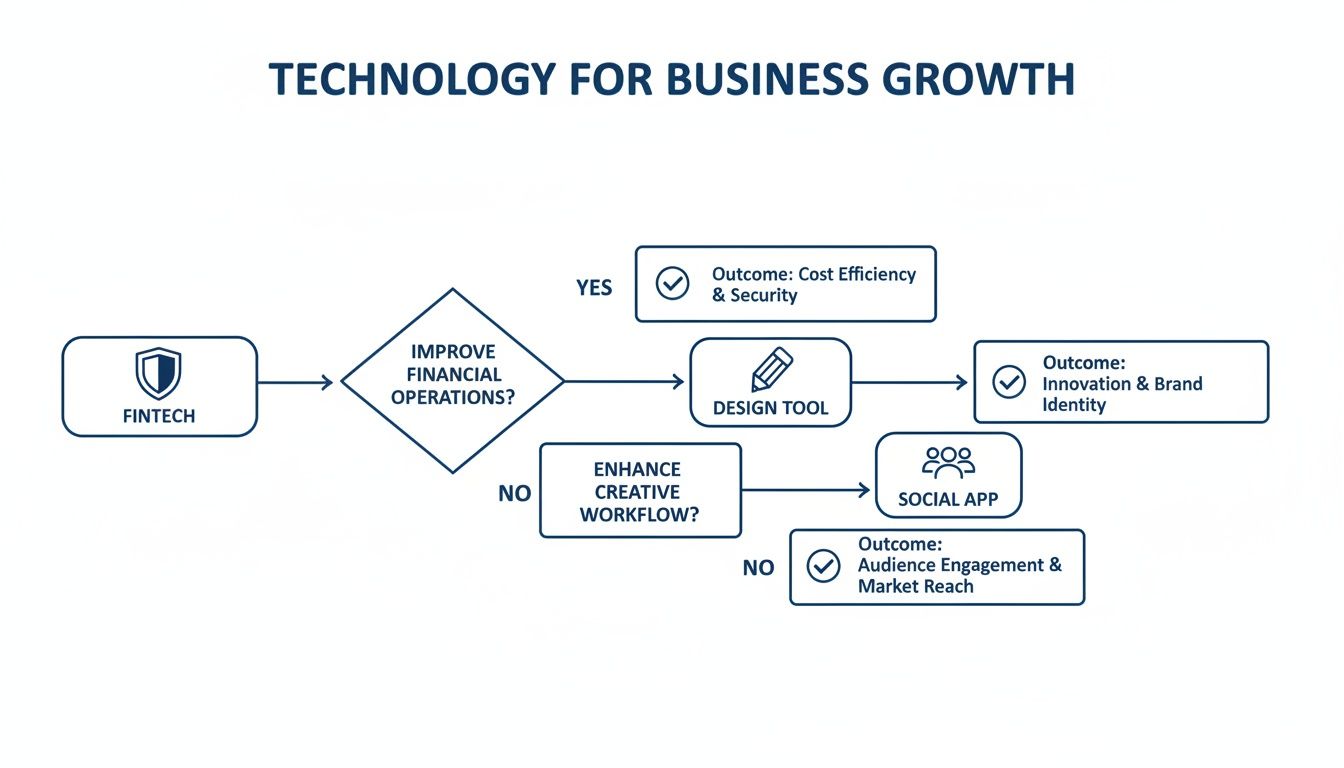
As you can see, a product’s core purpose dictates its foundation. Finance apps have to prioritize security, while creative tools need raw performance.
Your tech stack decisions are really just a series of trade-offs. The “Tech Stack Trade-Off Matrix” below breaks down how prioritizing one factor over another shapes your technology profile.
Tech Stack Trade-Off Matrix
| Priority | Influence on Tech Choice | Example Technology Profile |
|---|---|---|
| Speed | Prioritize frameworks with large ecosystems, pre-built libraries, and rapid development cycles. | Ruby on Rails, Django, or a full-featured framework like Next.js with a BaaS like Firebase. |
| Cost | Lean heavily on open-source software and services with generous free tiers. Be prepared for more hands-on DevOps. | A LAMP/LEMP stack (Linux, Apache/Nginx, MySQL, PHP/Python) on a budget VPS provider like DigitalOcean. |
| Scalability | Invest in a more complex, decoupled architecture from the start. Choose technologies known for handling high loads. | A microservices architecture using Go or Node.js, containerized with Docker, orchestrated with Kubernetes. |
| Talent | Select popular, mainstream languages and frameworks to access a larger pool of affordable developers. | JavaScript (React/Vue), Python (Django/Flask), or PHP (Laravel). Avoid niche or bleeding-edge tech. |
Each path comes with its own set of compromises. A speed-focused stack might accumulate technical debt, while a scalability-focused one might drain your runway before you even launch.
Making Strategic Sacrifices
Aligning your tech stack with your actual scalability needs is non-negotiable. Research shows that digital transformation projects have a dismal 35% success rate. Many of these failures come down to stack complexity. Companies trying to juggle five or more specialized data tools often drown in the overhead. In contrast, those who use modern, interoperable stacks report 70% faster query performance and a 50% TCO reduction.
This all means you can’t have everything, at least not right away. Your job is to make smart sacrifices.
- If speed is everything: You might pick a framework with a huge community and tons of plugins, even if it’s not the absolute fastest performer.
- If cost is the main barrier: You’ll be all-in on open-source and ready to manage more of the operational headaches yourself.
- If future scale is the #1 priority: You’ll spend more time upfront on a complex architecture, accepting a slower launch to future-proof your product.
For founders who want to skip a lot of these painful decisions, a pre-configured solution can be a massive shortcut. For instance, a comprehensive SaaS starter kit gives you a deployed, secure, and maintainable foundation from day one. It lets you focus on building features your customers care about instead of getting stuck wrestling with infrastructure choices. It’s a smart compromise that gives you speed without racking up a mountain of technical debt.
Looking Inward: Your Team and the Tech Ecosystem
The shiniest, most advanced tech stack on the planet is a lead weight if your team can’t use it. A choice that looks brilliant on paper can quickly sink your project if the people building it are struggling. This is where the human element isn’t just a factor—it’s the critical factor.
Before you get sold on the latest JavaScript framework or a hot new database, you have to do an honest skills inventory of your team. This isn’t about what they could learn; it’s about what they know inside and out, right now. Their existing fluency is your secret weapon for getting to market fast.
Think about it: if your lead developer is a React veteran, picking Vue.js because you read a compelling article is like asking a master carpenter to build a house with a brand new set of unfamiliar tools. It’s just not smart. Leaning into your team’s existing expertise means faster development, fewer head-scratching moments, and a much more solid first version of your product.
What Does Your Team Actually Know?
Don’t just ask, “Do you know Python?” You need to dig deeper. A quick, practical audit of your team’s real-world skills will give you the clarity you need to make a solid tech choice.
- Framework Fluency: Is your team deeply embedded in an ecosystem like Laravel or Ruby on Rails? I’m talking about knowing the libraries, the best practices, and, just as importantly, all the common traps and pitfalls.
- Database Experience: Have they spent years wrestling with relational databases like PostgreSQL, or is their comfort zone in NoSQL with something like MongoDB? A mismatch here is a recipe for architectural nightmares down the road.
- DevOps and Deployment Reality: Who on your team has actually pushed an application to production and kept it running? A stack that demands complex orchestration with Kubernetes is a terrible fit for a team that’s used to simple server deploys.
This isn’t about boxing yourself in. It’s about playing to your strengths. Honestly, choosing a stack your team already knows is the biggest cheat code you have for launching an MVP quickly and with fewer bugs.
The best tech stack is the one your team already knows. Productivity and speed don’t come from chasing trends; they come from mastery. Handing off that core knowledge to a tool you don’t fully grasp means you’re building a black box you can’t fix when it inevitably breaks.
Check the Pulse of the Tech Ecosystem
Your internal team is just one side of the coin. The external community and ecosystem around a technology are just as crucial. A healthy ecosystem is your safety net and your accelerator, giving you support when you’re stuck and tools to move faster.
When was the last time you were completely stuck on a coding problem? Chances are, you found the solution on Stack Overflow or a detailed blog post. That’s the ecosystem in action.
When you’re vetting a new technology, look for these vital signs:
- Active Hangouts: Are there busy forums on Stack Overflow, Reddit, or dedicated Discord servers where people are actively solving problems? This is your lifeline.
- Great Documentation: Is the official documentation clear, current, and packed with real-world examples? Terrible documentation is a massive red flag.
- Rich Library Support: Does it have a robust selection of third-party packages? A strong library ecosystem means you’re not reinventing the wheel for common things like payment processing or user auth.
- A Deep Talent Pool: How hard will it be to hire for this stack in six months? A year? Sticking to mainstream technologies makes finding future talent much easier and cheaper.
Developer adoption is a powerful signal of a technology’s long-term health. Look at Python’s massive growth, which is directly tied to the explosion in AI. With generative AI adoption hitting 75%, the 2025 Stack Overflow Developer Survey highlights its dominance. Companies are projected to spend $37 billion on genAI in 2025, and stacks built on Python and TensorFlow are showing a 3.7x ROI.
As a simple rule of thumb, I’d recommend avoiding niche tools with fewer than 10,000+ Stack Overflow tags. It’s a pragmatic way to ensure you can actually find and hire the talent you’ll need when it’s time to scale. You can dig into more AI adoption insights that might influence your stack choice.
Real-World Tech Stacks for Common SaaS Scenarios
Theory is great, but seeing how these frameworks play out in the real world is where it all clicks. Let’s walk through a few common SaaS ideas and break down why certain tech stacks make more sense than others.
The goal isn’t to hand you a perfect, one-size-fits-all solution. It’s to show you the reasoning behind the choices. You’ll start to see how a core business need—like instant message delivery—pushes you toward a completely different set of tools than a product that needs to crunch massive datasets.
For a B2B Analytics Dashboard
Picture a SaaS that pulls in sales data and turns it into beautiful, insightful dashboards for businesses. What are the non-negotiables? Data integrity is huge. So are complex querying capabilities and a rock-solid, professional frontend.
While getting to market is important, trust and accuracy come first. This immediately points toward a stack built on mature, robust technologies.
- Backend: Python with Django or Flask. Python is the king of data science for a reason. Libraries like Pandas and NumPy are built for the heavy lifting of data manipulation and complex calculations.
- Database: PostgreSQL. It’s the gold standard for reliability and handling complex queries efficiently. When data integrity is paramount, you don’t mess around. This is a must for any serious analytics tool.
- Frontend: React or Vue.js. Both are fantastic for building the kind of interactive, component-based UIs that analytics dashboards demand. Pair them with a library like D3.js or Chart.js for sophisticated data visualization.
- Infrastructure: AWS or Google Cloud. These giants offer a whole suite of managed services, from databases that scale on demand to powerful data warehousing solutions. This lets your product grow alongside your customers without constant re-architecting.
The logic is simple: lean on proven tools that have a long track record in data-intensive applications. Here, you’re choosing stability over the shiny new thing.
For a Real-Time Messaging App
Now, let’s switch gears completely. Think about an app like Slack or a live customer support chat. The number one, make-or-break priority is low-latency, real-time communication. If a message takes even a few seconds to arrive, the product is a failure.
This one, single requirement changes everything. The entire architecture needs to be optimized for handling thousands of persistent, simultaneous connections.
- Backend: Elixir with the Phoenix Framework. This might seem niche, but Elixir runs on the Erlang VM, which was literally designed to power massive, concurrent telecom systems. It’s built from the ground up for this exact problem.
- Database: ScyllaDB or PostgreSQL. A distributed NoSQL database like ScyllaDB is built for insane write speeds, perfect for a high volume of messages. That said, PostgreSQL is still a versatile and powerful choice.
- Frontend: React Native or native iOS/Android. For a mobile-first chat app, React Native lets you share a lot of code between platforms. But for the absolute best performance and responsiveness, nothing beats going fully native.
- Real-Time Layer: WebSockets. This is the core of the whole operation. WebSockets provide that persistent, two-way communication channel that makes instant messaging possible.
See the difference? The core business need—instant communication—guides every single decision, pushing you toward a specialized but incredibly powerful tech stack.
Choosing a tech stack is an exercise in identifying your single most important technical challenge and building your foundation around solving it. For analytics, it’s data integrity. For messaging, it’s concurrency.
When to Skip Building from Scratch
Let’s be honest. For most founders, especially if you’re a solo developer or a small team, building all this infrastructure from the ground up is a long, expensive, and frankly, risky road. This is where managed platforms and SaaS boilerplates become a massive strategic advantage.
They give you a shortcut by providing a pre-built, secure, and scalable foundation.
Instead of burning weeks setting up user authentication, wrestling with subscription billing logic, and configuring deployment pipelines, you can start working on your unique features from day one. Platforms like saasbrella are designed to handle all that undifferentiated heavy lifting, giving you a production-ready stack right out of the box.
If you’re curious, you can explore the pre-configured tech stack these platforms are built on.
This is a classic trade-off: you give up a little bit of low-level control for a huge boost in speed and a massive reduction in complexity. For most MVPs, that’s an incredibly smart trade. You’re not just buying code; you’re buying time, which is always your most valuable resource.
Making a Confident Decision and Moving Forward
You’ve done the hard work of analyzing the trade-offs and mapping out your options. Now comes the moment of truth: it’s time to commit. This final step is all about turning your research into a concrete decision that actually lets you start building something.
This isn’t about chasing some mythical “perfect” tech stack. Forget that. The goal is to make a smart, informed choice that works for your product right now, with a clear-eyed view of both its strengths and its limitations.
Build a Small Proof-of-Concept
Before you go all-in, it’s worth validating your core assumptions with a tiny proof-of-concept (PoC).
Think of a PoC not as a mini-MVP, but as a quick, surgical experiment. Can your chosen database really handle the specific data structure you need? Does that hot new frontend framework actually make building your core interactive component feel intuitive, or is it a struggle?
Spending a few days on this can save you from months of future frustration. It’s the final reality check that uncovers those nasty little friction points before you’ve sunk significant time and money into the project.
For a more structured way to weigh your final contenders, a tool like the Decision Matrix Framework can bring a lot of clarity. It helps you score your options against the criteria you’ve defined, giving you a data-driven reason for your final call.
Your tech stack is a foundation, not a cage. The goal is to make the best decision you can with the information you have today, knowing you can—and will—evolve and adapt as your product finds its footing and your needs change.
Finally, do your future self (and your future team) a huge favor: document the “why” behind your decision. A short write-up explaining the trade-offs you considered and the reasons for your choice is invaluable. It helps new hires get up to speed on the architectural philosophy and keeps future decisions consistent.
Once that’s done? Lock it in and start building.
Got Questions About Picking a Tech Stack?
It’s totally normal to hit a few common sticking points when you’re wrestling with tech stack decisions. Let’s walk through some of the questions that pop up time and time again for founders and developers.
How Often Should I Re-Evaluate My Tech Stack?
Honestly? You shouldn’t be constantly second-guessing your core technologies. A good rule of thumb is to do a high-level review once a year or whenever you’re planning a huge product evolution.
But unless you’re hitting painful, obvious roadblocks in scalability or your team’s development speed is grinding to a halt, resist the temptation to chase the shiny “next big thing.” A stable, predictable stack is often way more valuable than a trendy one.
Can AI Just Choose My Tech Stack for Me?
Not really, and you probably wouldn’t want it to. While tools like AI coding assistants are fantastic for writing code within a stack, they can’t make the strategic business call for you.
An AI can spit out a common stack based on patterns it’s seen, but it has zero context on your specific business goals, your runway, or the unique skills of your team.
The best tech stack is still the one you and your team deeply understand. Relying on an AI to build with unfamiliar technology is like outsourcing control; you can’t effectively debug, maintain, or scale a system you don’t truly grasp. Use AI to accelerate work within your chosen stack, not to choose it for you.
Is It a Mistake to Choose a “Boring” Technology?
Absolutely not. In fact, it’s often the smartest move you can make.
Choosing something well-established and battle-tested—like Python with Django or a classic LAMP stack—is a pragmatic business decision. These “boring” stacks have massive communities, incredible documentation, and a deep talent pool, which dramatically cuts down your risk and makes hiring so much easier.
Remember, the goal is to build a successful business, not to win a tech novelty contest.
Ready to skip the setup and start building your product? saasbrella gives you a complete, production-grade foundation for your SaaS, so you can focus on features instead of wrestling with infrastructure. Launch your secure MVP in minutes, not months.
Ready to build?
Get Started for Free. Build on a production-ready foundation with authentication, database, and deployment already configured.
No credit card required. Cancel anytime.