How to Build a Waitlist for SaaS That Actually Converts
Building a waitlist for your SaaS is about more than just a landing page and a signup form. It’s about setting up a high-conversion experience, baking in a referral system that encourages people to share, and consistently keeping your sign-ups engaged.
The goal? Validate your product and build a genuine community before you launch. This way, you have paying customers lined up from the moment you go live.
Why a Waitlist Is Your SaaS Secret Weapon
Let’s get one thing straight: a pre-launch waitlist isn’t just a marketing trick to manufacture hype. It’s a foundational strategic tool for any serious SaaS founder. Too many first-timers fall for the “genius founder fallacy,” sinking months and thousands of dollars into a product only to find out nobody actually wants it.
A waitlist flips that script entirely. It forces you to find your customers first, dramatically de-risking the whole venture.
But it’s about more than just collecting email addresses. A well-executed waitlist serves several crucial functions that lay the groundwork for a massive launch.
- Product-Market Fit Validation: This is your earliest possible signal that you’re solving a real problem. If someone won’t even trade their email for your solution, they’ll never give you their credit card.
- Community Building: This is where you gather your tribe. These early adopters are your future evangelists, your first source of critical feedback, and the spark that ignites your brand.
- Launch Momentum: Instead of launching to crickets, you launch to a crowd of people who are already invested in your story and genuinely excited to get their hands on your product.
This simple workflow shows how a waitlist turns a simple idea into a validated, community-backed product that’s ready to fly.
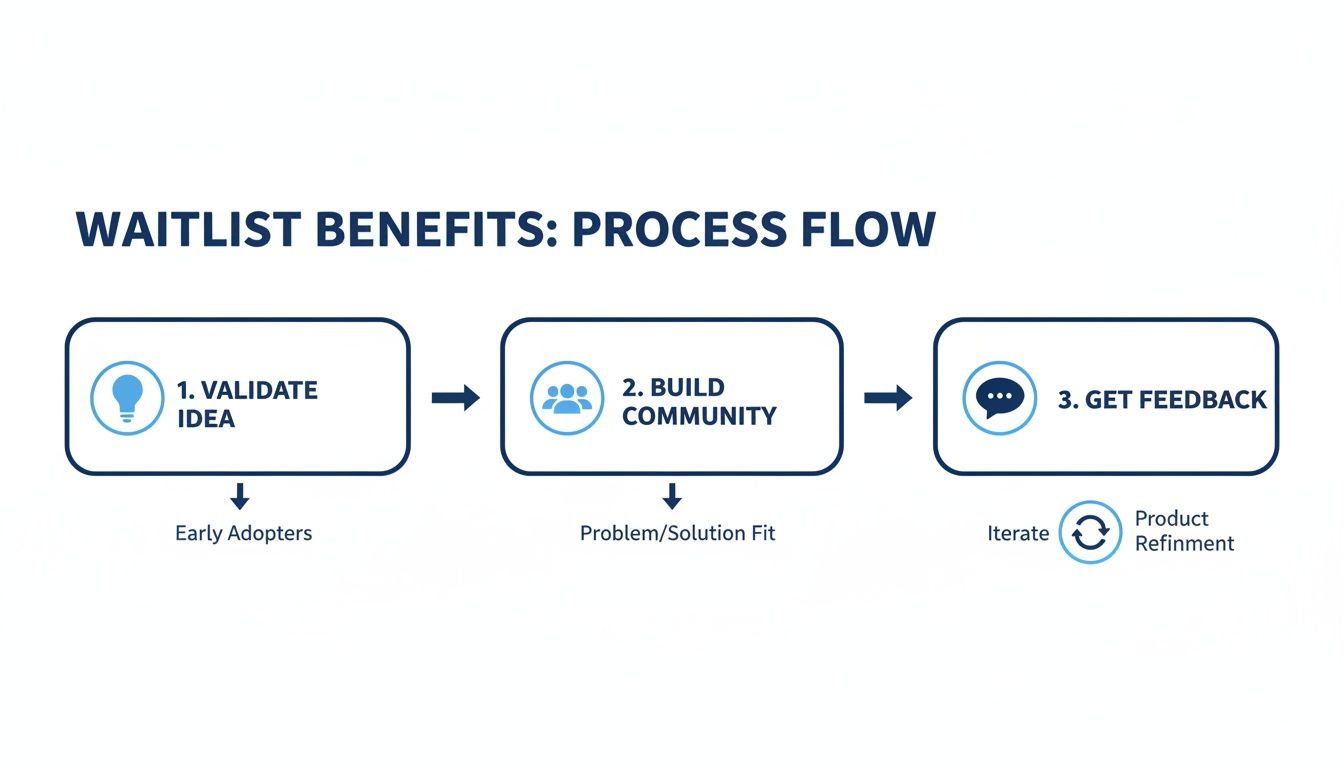
Each of these steps builds on the last, creating a powerful feedback loop that makes both your product and your marketing stronger long before you ever hit “launch.”
Fueling Early Growth and Conversions
The numbers behind a solid waitlist strategy don’t lie. For digital products, industry benchmarks show conversion rates from a waitlist can range anywhere from 25% to 85%. That absolutely crushes the typical 2-4% you see from traditional marketing channels.
But here’s the catch—timing is everything. If you let people off the waitlist within a month, conversions often hover around a healthy 50%. Let that stretch beyond three months, and you’ll see them plummet to below 20%. People move on.
A waitlist turns marketing from a guessing game into a data-driven process. You’re not just hoping people will show up on launch day; you’re building a direct line of communication with them, turning passive interest into active anticipation.
Key Waitlist Success Metrics at a Glance
To put this in perspective, here are some of the critical benchmarks that show just how powerful a well-run waitlist can be for a new SaaS.
| Metric | Industry Benchmark | Key Takeaway |
|---|---|---|
| Waitlist Conversion Rate | 25% - 85% | Far outperforms standard marketing, showing the power of a warmed-up audience. |
| Conversion (within 1 month) | ~50% | Highlights the importance of launching while excitement is still high. |
| Conversion (after 3 months) | <20% | Momentum is perishable. Long delays kill conversion rates. |
| Referral Signup Rate | 15% - 30% | Shows that incentivized sharing is a major growth lever. |
These figures aren’t just vanity metrics; they represent a direct path to de-risking your launch and securing those crucial first customers.
The Foundation of Your Marketing Efforts
While a waitlist is laser-focused on capturing those early adopters, the principles behind it are timeless. Understanding effective strategies for building email lists that grow your business gives you a huge advantage.
It all comes down to crafting a compelling value proposition, making it dead simple to sign up, and delivering consistent value from day one. By focusing on these core fundamentals, you’re not just building a list; you’re building a strategic asset that will pay dividends for years to come.
Crafting Your High-Conversion Waitlist Landing Page
Your landing page isn’t just a signup form; it’s the front door to your entire project. This is the single most critical asset in your quest to build a SaaS waitlist. Get it right, and you’ll create a steady stream of eager early adopters. Get it wrong, and even the best product idea will struggle to gain traction.
Forget about fancy animations or complex designs for a moment. The primary job of this page is to communicate value clearly and persuade a visitor to give you their email address. Every single element must work toward this one goal.
The Anatomy of a Killer Value Proposition
Before anyone even thinks about signing up, they need to know what you’re offering and why it should matter to them. Your headline and sub-headline are the most important words on the entire page. They have to instantly answer the visitor’s silent question: “What’s in it for me?”
A powerful value proposition is specific, punchy, and laser-focused on the outcome. Don’t say “A new way to manage projects.” Instead, try something like “The project management tool that saves creative agencies 10 hours a week.” See the difference? The first is generic fluff; the second promises a tangible, desirable result.
To nail your messaging, stick to this simple structure:
- A Clear Headline: State the primary benefit in one powerful sentence.
- A Supporting Sub-headline: Briefly explain what you do and who it’s for.
- Three Key Benefit Bullet Points: List the top three outcomes or features that solve your audience’s biggest pain points.
This framework gives visitors a clear hierarchy of information, letting them grasp your core value in seconds.
Designing a Frictionless Signup Experience
The signup form itself is where so many founders overthink things. It’s tempting to ask for a name, company role, or industry, but every extra field you add creates friction and kills conversions. At this stage, your only goal is to capture an email.
Make the process mind-blowingly simple. Your form needs just one field: Email Address. That’s it. You can always gather more info later, after you’ve earned their trust.
The core principle here is to minimize the “ask.” You’re asking a stranger for their contact info based on a promise. The smaller the ask, the higher the odds they’ll say yes. Make joining a total no-brainer.
The call-to-action (CTA) button is just as crucial. Ditch generic text like “Submit” or “Sign Up.” Instead, use action-oriented copy that reinforces the value. Think “Get Early Access” or “Join the Private Beta.” This small tweak frames the action as a benefit, not a chore.
Making the Intangible Tangible
One of the biggest hurdles with a pre-launch SaaS is that your product doesn’t exist yet. You’re selling a vision, an idea. Your landing page has to make that vision feel as real as possible. This is where visuals are your best friend.
- High-Fidelity Mockups: Create realistic images of what your app will actually look like. Show off the clean dashboard, the key features in action, and the beautiful UI. This helps people truly visualize themselves using your product.
- Short Demo Videos: A quick 30-60 second video can communicate your value far more effectively than paragraphs of text. A simple screen recording with a voiceover walking through the core workflow can be incredibly powerful.
These visual assets bridge the gap between concept and reality, making your future SaaS feel like a real solution that’s just around the corner. To make sure your visuals and copy are actually working, you have to test them. Using a powerful landing page builder with A/B testing capabilities lets you experiment with different headlines, images, and CTAs to find the combination that converts best.
Harnessing Social Proof and Urgency
People are naturally drawn to what others are doing. You can use this psychological trigger to your advantage, even before you have a single paying customer. Social proof creates a sense of momentum and makes visitors feel like they’re joining a movement.
A simple but incredibly effective tactic is to add a counter to your landing page. A small line of text like “Join 1,200+ other innovators” can dramatically increase signups. It signals that other smart people have already seen the value in what you’re building, which reduces the perceived risk for new visitors.
This tiny addition transforms your waitlist from a static form into a growing community that people genuinely want to be part of.
Building a Viral Loop to Fuel Your Growth
Exponential growth isn’t a happy accident; it’s engineered. A static waitlist is a decent start, but a dynamic, self-propagating one is the real goal. This is where you turn every new sign-up into a brand advocate by building a viral loop—a system where users are incentivized to refer others, creating a growth engine that runs itself.
The core idea is simple: reward people for sharing. The moment someone signs up, you arm them with a unique referral link and a crystal-clear reason to use it. This simple step transforms passive interest into active promotion, creating a flywheel effect that can seriously accelerate your waitlist growth.
Designing a Reward Structure That Actually Motivates
Your referral incentive is the fuel for your viral loop. Get it wrong, and the whole system sputters out. But a compelling reward can trigger an explosion of sign-ups. The trick is to offer something your specific audience genuinely values.
Here are a few reward structures that consistently work:
- Priority Access: This is the classic for a reason—it’s incredibly effective. Nobody likes waiting in line. You can gamify this by creating a tiered system where more referrals move someone higher up the queue, tapping into a powerful sense of competition.
- Exclusive Features: Offer early access to a premium feature that won’t be in the free or basic plan at launch. This not only motivates sharing but also starts pre-selling users on the value of your paid tiers.
- Product Credits or Discounts: If your SaaS has a clear future cost, offering credits (like “$50 in credits for every 5 successful referrals”) is a powerful motivator. It gives users a tangible financial stake in your launch’s success.
The best rewards tie directly back to your product’s core value. They give users more of what they signed up for in the first place, making the act of sharing feel completely natural.
Don’t just offer a reward; frame it as a challenge. Use language like “Leapfrog the competition” or “Unlock your Pro features early.” This turns a simple referral program into an engaging game that users actually want to win.
Making Sharing Effortless
Even the most amazing incentive won’t work if sharing is a hassle. Your job is to hunt down and eliminate every ounce of friction from the sharing process. After a user signs up, their referral dashboard should be a one-stop shop for promotion.
This means you need to arm them with pre-written, compelling copy they can use with a single click. Make sure they have:
- One-Click Social Posts: Simple buttons for Twitter, LinkedIn, and Facebook that auto-populate a well-crafted message.
- A Pre-Written Email Template: Let them easily email their network without having to think about what to say.
- A Simple “Copy Link” Button: This is essential for sharing in private channels like Slack, Discord, or anywhere else.
The goal is to make sharing feel like a two-second action, not a chore. The easier you make it, the more people will do it.
The Technology Behind the Magic
Executing a viral loop requires a solid tech stack to manage the logic, track referrals, and automate reward fulfillment. While you could absolutely build this from scratch, it’s often faster and more reliable to lean on dedicated tools. Solutions like SaaSBRella, for instance, provide a suite of waitlist launch campaign tools that handle everything from unique link generation to leaderboard management right out of the box.
The right platform lets you focus on your product and marketing message, not on debugging referral attribution logic.

This image shows a clean, simple waitlist signup form. That simplicity is key—it minimizes friction at the very first step, which is crucial before you even introduce the referral mechanic.
Leveraging viral mechanics is a proven way to build a massive SaaS waitlist. For SaaS, benchmarks show 25-60% conversion rates from waitlist to user, but the real magic happens pre-launch. Think about it: 80% of people will wait 1-3 days for early access if they’re properly incentivized. By engineering this loop, you’re not just collecting emails; you’re building an army of evangelists before you’ve even launched.
Keeping Your Waitlist Engaged Until Launch Day
Getting an email address is a win, but it’s just the start of the race. The real challenge when you build a waitlist for SaaS is battling “waitlist fatigue”—that slow, creeping disinterest that can turn a hot lead into a cold one by the time you launch. A static list of emails is worthless; you need a dynamic, engaged community.
Your goal is to transform the waiting period from a passive delay into an active, value-packed experience. This isn’t about spamming people with “we’re still working on it!” emails. It’s about building a relationship and making them feel like insiders, so when you finally open the doors, they’re not just ready—they’re excited.
Crafting a Winning Communication Cadence
The key is finding the sweet spot between staying top-of-mind and becoming an annoyance. Sending an email every other day is a surefire way to get unsubscribes. Conversely, going silent for two months guarantees they’ll forget who you are.
A communication cadence of one valuable email every 1-2 weeks is a solid starting point. This rhythm is frequent enough to maintain momentum without overwhelming your audience. Each email has to provide genuine value—hype alone won’t cut it.
The golden rule of waitlist communication: Every email should make your audience smarter, more informed, or feel more connected to your journey. Treat them like early investors in your vision, not just names on a list.
Your Essential Email Nurture Sequence
Your emails should follow a logical progression, taking the user from a curious prospect to an educated evangelist. Each message has a specific job to do.
Email 1 The Instant Welcome This email should be automated to fire off the moment someone signs up. Its purpose is threefold:
- Confirm their spot on the waitlist.
- Thank them for their interest and make them feel welcome.
- Clearly restate the core value proposition of your SaaS.
Email 2 The ‘Behind the Scenes’ Update A week or so after they join, send an update that pulls back the curtain. Share a screenshot of a new feature you’re working on, introduce a team member, or talk about a specific challenge you overcame. This builds authenticity and makes your journey relatable.
Email 3 The Educational Deep Dive This is where you provide pure value. Write a short piece of content that solves a small problem for your target audience—a problem related to what your SaaS will eventually solve. This positions you as an expert and builds trust long before you ask for a sale. It’s worth exploring different email marketing and newsletter platforms to manage this sequence effectively.
Email 4 The Final Countdown As you get close to your launch date, start building anticipation. Announce the official launch date and remind them of the exclusive benefits they’ll get for being on the waitlist. This is the final push to get them excited for what’s coming.
The Power of Consistent Engagement
Maintaining this consistent, value-driven communication is critical. Don’t underestimate how much timing and engagement impact your launch day success. Industry data reveals a staggering difference: conversion rates average around 50% for waitlists under one month but plummet to under 15% for those stretching past six months.
Regular updates can lift conversions by 25%, actively combating the waitlist fatigue that affects a reported 70% of SaaS projects. This consistent contact transforms your list from a collection of leads into a primed community, eager to become your first paying customers.
Driving Targeted Traffic to Your Waitlist
Okay, so you’ve built a killer landing page. That’s a great first step, but it won’t promote itself. You can’t just hit “publish” and expect a flood of sign-ups. Now comes the real work: getting the right people to actually see it.
We’re not talking about just any traffic. The goal is to find individuals who are genuinely feeling the pain your SaaS is designed to solve. These are the people who will become your first believers, your most engaged users, and ultimately, your first paying customers. Forget the “build it and they will come” fantasy.

Go Where Your Audience Already Gathers
The most powerful thing a bootstrapping founder can do is become part of the communities where your ideal customers already live online. This is about contributing, not spamming. Before you even think about dropping a link, you need to become a valuable, recognized member of the conversation.
- Niche Subreddits: Find the subreddits dedicated to your industry or the specific problem you’re tackling. Jump into discussions, answer questions, and offer real help.
- Slack and Discord Communities: Join professional groups and make yourself known as a go-to resource. Share what you know freely and build genuine relationships.
- Indie Hackers or Product Hunt: Get involved with other founders and builders. When you’re seen as a peer who’s solving a real problem, sharing your waitlist becomes a natural part of the conversation, not a sales pitch.
This approach builds trust and social proof. By the time you share what you’re working on, the community already knows and respects you, leading to much higher-quality sign-ups.
Use Content as a Magnet for Qualified Leads
Content marketing for a waitlist doesn’t require launching a massive blog. Instead, pour your energy into creating one or two high-value “pillar” articles that directly address a core pain point for your target audience.
Think about a problem your SaaS will eventually solve, and then write the most comprehensive guide you can on how to tackle it manually. This move instantly positions you as an expert and naturally pulls in people who are actively searching for that exact solution. At the end of the guide, you can casually introduce your waitlist as the automated, smarter way to solve that problem for good.
Your pre-launch content should act as a bridge. It meets your audience where they are—struggling with a problem—and guides them toward the solution you are building. It’s about educating first and selling second.
To get the most out of your content, it’s worth looking into some powerful SaaS SEO tools. They can help you find the right keywords to target and see how your content is performing, ensuring you’re not just creating content but creating content that gets found.
Finding the Right Mix of Promotion Channels
While grassroots organic efforts are the foundation, a multi-channel approach can really kick things into high gear. To help you decide where to focus your energy, here’s a quick breakdown of common promotion channels.
Waitlist Promotion Channel Comparison
| Channel | Cost | Effort Level | Best For |
|---|---|---|---|
| Community Engagement | Free | High | Building trust and attracting highly qualified, early-adopter users. |
| Content Marketing/SEO | Low to Medium | High | Attracting users with high intent who are actively seeking solutions. |
| Social Media (Organic) | Free | Medium | Building a brand presence and engaging directly with potential users. |
| Micro-Influencers | Low to Medium | Medium | Tapping into established, niche audiences with high trust. |
| Targeted Ads (PPC) | High | Medium | Quickly testing messaging and reaching a very specific, defined audience. |
| Product Hunt/BetaList | Free | Low | Gaining initial visibility and feedback from an early-adopter community. |
Each channel has its place. Building relationships with micro-influencers in your niche, for example, can give you a massive boost. These are people with smaller but incredibly engaged followings who can introduce your project to a perfectly aligned audience.
If you have some budget, even small, hyper-targeted ad campaigns can work wonders. Running ads on a platform like LinkedIn, where you can target specific job titles and industries, lets you put your landing page right in front of your ideal customer profile. The key is to start small, measure everything, and only pour more money into what’s proven to work.
Using Waitlist Data to Prepare for a Smooth Launch
Your waitlist isn’t just a list of emails collecting dust. Think of it as a living dashboard reflecting your pre-launch health. This data is the secret to turning a hopeful launch into a strategic, successful one. By digging into the numbers now, you can spot weaknesses, double down on what’s working, and make sure you’re truly ready for day one.
If you only see a count of sign-ups, you’re missing the real story. This is your first chance to understand your early adopters before they’ve even touched the full product. The numbers will tell you how excited they really are.
Decoding Your Pre-Launch Metrics
Before you even think about hitting the “launch” button, you need to get intimate with three core metrics. These are your vital signs. They tell you what’s working and what needs a serious tune-up, fast.
- Sign-Up Conversion Rate: Simple but powerful. What percentage of visitors to your landing page actually join the waitlist? A low number might mean your value proposition isn’t hitting the mark or your page is just plain confusing.
- Viral Coefficient (K-factor): This is your growth engine’s report card. It measures how many new users each existing user brings in through referrals. If your K-factor is below 1.0, your viral loop isn’t self-sustaining. It’s a strong signal that your referral incentive isn’t juicy enough.
- Email Engagement: Are people opening your emails? Are they clicking the links? Low open and click-through rates are a huge red flag for “waitlist fatigue.” Your messaging isn’t keeping them hooked, and you risk them forgetting who you are by the time you launch.
Looking at these metrics together gives you a brutally honest picture. For instance, a high conversion rate but a low K-factor tells you that people love your idea, but your referral mechanics need work.
Building Your Strategic Launch Checklist
Armed with real data, you can now ditch the “launch to everyone and pray” strategy. A controlled, staggered launch is the way to go. It minimizes risk, lets you squash early bugs, and helps you gather high-quality feedback when it matters most.
A staggered launch isn’t about creating fake exclusivity. It’s about creating a controlled environment where you can give your first users an amazing experience, fix problems quickly, and build momentum thoughtfully.
Use your waitlist data to create a launch plan that rolls out access to your most valuable sign-ups first.
1. Segment Your Waitlist for a Phased Rollout Not all sign-ups are created equal. Use your referral and sign-up data to create priority tiers and reward the people who have helped you the most.
- Tier 1 (The Super Fans): These are your top referrers, the evangelists who did the heavy lifting for you. Let them in first. They’ve earned it.
- Tier 2 (The Ideal Customers): If you collected any extra info (like roles or company size), segment the users who perfectly match your ideal customer profile. Their feedback will be gold.
- Tier 3 (The Early Believers): These are the folks who signed up way back at the beginning. They took a leap of faith on your vision, so show them some love by giving them early access.
2. Craft the Perfect ‘You’re In!’ Email This isn’t just a notification; it’s the start of the user experience. Your “welcome” email needs to reignite excitement, clearly explain what to do next, and tell them exactly how to give feedback. Make them feel like the VIPs they are.
3. Prepare Your Support and Feedback Channels Before a single user logs in, have your support system ready. This could be as simple as a dedicated email address or a private Discord channel. The onboarding experience for your very first users is critical—get it right, and they’ll become your biggest advocates. Get it wrong, and you’ll be fighting an uphill battle. This feedback loop is what turns a promising waitlist into a thriving product.
Got Questions? We’ve Got Answers
Building a waitlist always brings up a few common questions. Let’s tackle them head-on, based on what we’ve seen work (and what hasn’t).
How Long Should a Waitlist Run Before Launch?
There’s no single magic number, but we’ve found the sweet spot is typically one to three months.
This gives you enough time to build real momentum and get priceless feedback, but it’s short enough that the initial excitement doesn’t fizzle out. Keep in mind that timing is everything. Data consistently shows that waitlist conversions hover around a healthy 50% when people get access within a month, but that number takes a nosedive if they’re left hanging for more than three months. Your job is to strike that perfect balance between growing your list and keeping the energy high.
What Are the Best Tools for Managing a SaaS Waitlist?
For a simple, no-fuss setup, you can absolutely get by with a solid landing page builder like Webflow hooked up to an email service like Mailchimp. It works.
But if you’re serious about turning this waitlist into a growth machine, you’ll want something more powerful. Think automated referral tracking, tiered rewards, and leaderboards. Purpose-built platforms handle all that messy back-end logic for you, which saves a ton of development time.
A basic waitlist is a start, but a dedicated tool is what turns it into a viral engine. It’s the automation of referral mechanics that really fuels growth, letting you stay focused on shipping your product.
Help! My Waitlist Growth Is Stalling. What Do I Do?
First, don’t panic. Slow growth isn’t a failure; it’s a signal telling you it’s time to diagnose the problem and make some changes. We always start by looking at three core areas:
- Your Landing Page: Is your value proposition impossible to ignore? Does your call-to-action scream “click me”? If not, rework the copy.
- Your Traffic Sources: Are you actually promoting this where your ideal customers hang out? A great waitlist page is useless if the right people never see it.
- Your Referral Incentive: Is the reward truly compelling? Is it something people actually want enough to tell their friends about?
Don’t be shy about A/B testing everything—headlines, button colors, and especially the incentives. You’d be surprised how often a small tweak can unlock a major boost in sign-ups.
Ready to stop wrestling with DevOps and start building your product? saasbrella provides a production-grade, AI-ready foundation with a built-in waitlist system so you can launch in minutes, not months. Get your secure SaaS boilerplate today.
Ready to build?
Get Started for Free. Build on a production-ready foundation with authentication, database, and deployment already configured.
No credit card required. Cancel anytime.