How to Build a SaaS MVP and Launch Your Product Faster
Before you write a single line of code, you need to be brutally honest about one thing: are you building something people actually want?
It’s a simple question, but ignoring it is the #1 killer of startups. We get it. You have a brilliant idea, and the urge to start building is immense. But launching a product nobody will pay for is a fast track to burnout and an empty bank account. This is where validation comes in—it’s your insurance policy against building a beautiful solution to a nonexistent problem.
The goal isn’t to get friends to say, “Yeah, that sounds cool!” The goal is to get cold, hard evidence that a specific group of people has a problem they are actively trying to solve and are willing to pay for a better way.
Think about the costs. A simple SaaS MVP in 2025 can set you back anywhere from $10,000 to $100,000, depending on complexity. That’s a massive range. Getting validation right ensures you’re spending that money on features that matter, not just features you think matter.
Uncovering Genuine Pain Points with Customer Interviews
Forget online surveys and focus groups for now. Your first job is to talk to actual human beings who you believe are your target customers. The goal isn’t to pitch your idea; it’s to listen.
Don’t ask leading questions like, “Would you use an app that does X?” People are nice. They’ll say yes. Instead, dig into their current reality.
- “Can you walk me through how you currently handle [the process your SaaS will improve]?”
- “What’s the most frustrating part of that?”
- “What tools have you tried to solve this? What did you like or dislike about them?”
You’re listening for emotion. When someone’s voice changes—when you hear genuine frustration, annoyance, or resignation—you’ve hit gold. That’s a real pain point. To keep these conversations organized, it’s a good idea to use dedicated customer interview research tools to structure your questions and spot patterns in the answers.

Testing Demand with No-Code Landing Pages
Once you’ve heard the same problem a few times, it’s time to see if people will actually act on it. This is where a simple landing page becomes your most powerful tool. You don’t need a product yet, just the promise of one.
Fire up a tool like Carrd or Webflow and build a one-page site in an afternoon. This page needs to do one job: clearly articulate the problem you uncovered and present your solution in a compelling way.
The most critical part is the call-to-action (CTA). Don’t settle for a weak “Learn More.” You need to test for real intent.
Pro Tip: Your CTA should ask for a small but meaningful commitment. “Join the Waitlist” is okay, but “Request Early Access” is better. Even stronger? “Pre-order for a 50% Lifetime Discount.” This separates the mildly curious from genuinely interested customers.
This simple test gives you hard data. If you can’t convince people to give you their email address for a solution to a problem they claim to have, you either need to rethink your messaging or go back to the drawing board with the idea itself. It’s a tough pill to swallow, but it’s far cheaper than building an entire product nobody will use.
Comparing Idea Validation Methods
Not all validation methods are created equal. Some are quick and cheap, while others require more effort but deliver stronger signals. Here’s a breakdown to help you choose the right approach for your stage.
| Validation Method | Primary Goal | Pros | Cons |
|---|---|---|---|
| Customer Interviews | Discover deep insights & pain points | High-quality qualitative data. Uncovers “unknown unknowns.” | Time-consuming. Not statistically significant. |
| No-Code Landing Page | Gauge initial interest & collect leads | Fast and cheap to set up. Provides quantitative data (e.g., conversion rate). | Doesn’t validate willingness to pay unless a pre-order is involved. |
| ”Concierge” MVP | Solve the problem manually for a few clients | Proves value without writing code. Builds deep customer relationships. | Not scalable. Can be very time-intensive. |
| Explainer Video/Demo | Communicate a complex value proposition | Highly engaging. Can simulate the product experience before it’s built. | Can be expensive to produce a quality video. |
Each of these methods helps you de-risk your idea before investing heavily in development. The goal isn’t to find one perfect method, but to layer them. Start with interviews to find the pain, use a landing page to test your messaging, and maybe even run a concierge MVP for your first few users to prove you can deliver real value.
Defining Your Core Features and MVP Scope
Alright, you’ve validated your idea. Now comes the hard part—and it’s not the coding. It’s fighting the urge to build everything. This is where most founders get stuck, burning months building a bloated product that doesn’t solve any single problem well.
Building a SaaS MVP isn’t about shipping a smaller version of your grand vision. It’s about finding the absolute smallest thing you can build that delivers a “wow” moment for your first users. The goal is to isolate that single, critical workflow that makes someone say, “This is so much better than how I was doing it before.” Everything else is noise.
Prioritizing Ruthlessly with MoSCoW
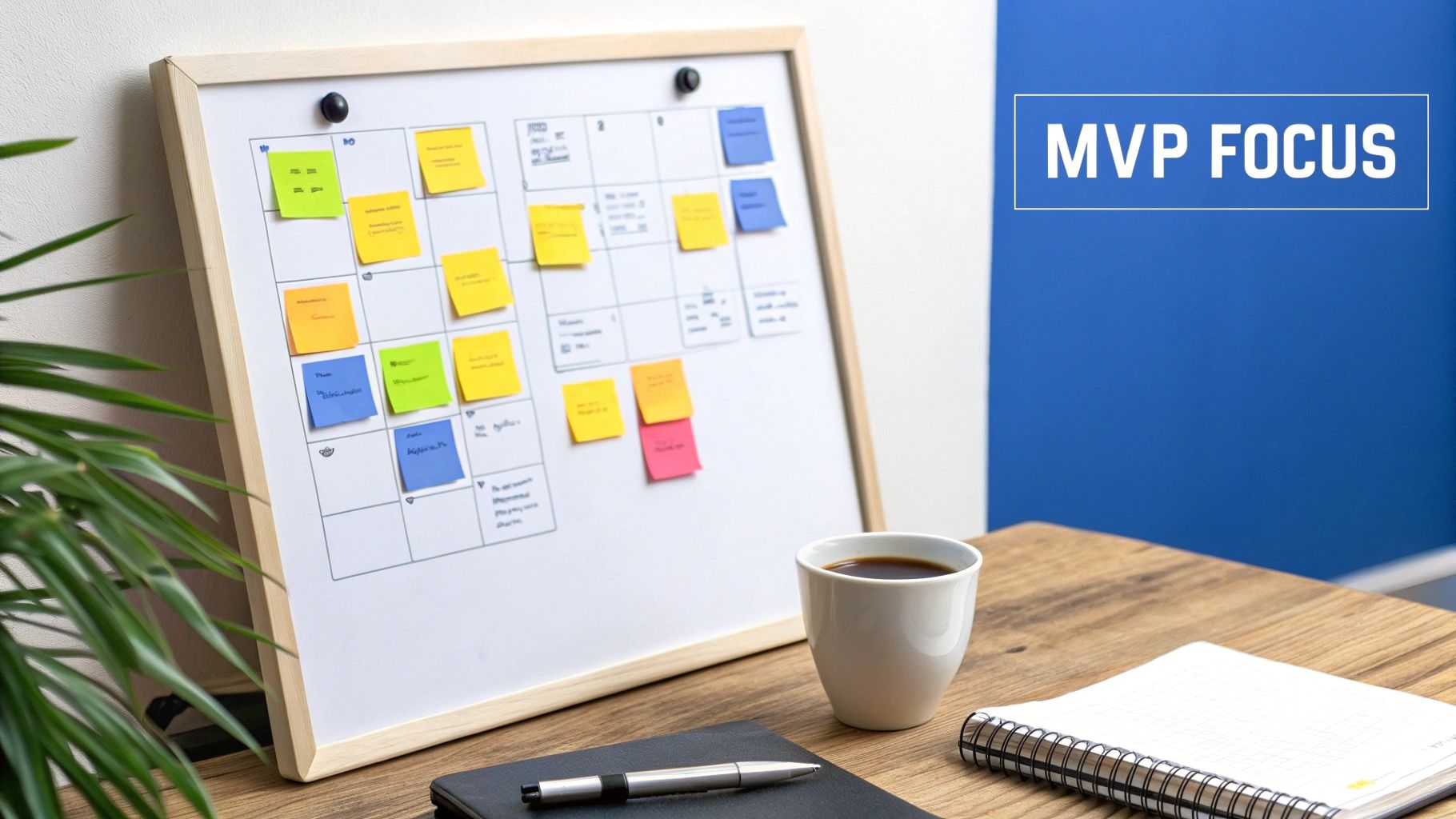
A simple framework to keep you honest is the MoSCoW method. It forces you and your team to be brutally realistic by bucketing every potential feature into one of four categories.
- Must-Have: These are the non-negotiables. If you don’t build these, the product is fundamentally unusable for its core purpose. Think user login, the main dashboard, and the one key action a user needs to perform.
- Should-Have: Important, but not critical for day one. The product works without them, but they add significant value. An example might be exporting data or setting up a second type of notification.
- Could-Have: These are the nice-to-haves. They add polish but don’t solve the core problem. Think dark mode or custom themes. Save them for later.
- Won’t-Have (for now): This is your “not right now” list. It’s the most important category for protecting you from scope creep. Be aggressive here. If you’re not sure, it belongs here.
Your MVP is just the “Must-Have” list. That’s it. Nothing else.
The biggest mistake I see founders make is letting “Should-Have” features sneak into the MVP. It starts with one small thing, then another, and suddenly your launch is three months late. Be ruthless. You can always build the “Should-Haves” in the first sprint after you launch, guided by real user feedback.
Visualizing the Journey with User Story Mapping
While MoSCoW tells you what to build, user story mapping tells you how it all fits together from the user’s perspective. This simple exercise prevents you from building a random collection of features and ensures you’re creating a logical, valuable workflow.
Think of it as a grid. The horizontal axis maps out the major steps a user takes to solve their problem, from signing up to achieving their goal. The vertical axis lists the specific actions or features within each of those steps.
Let’s use an example: a SaaS for freelance writers to create and send invoices.
The core journey might look like this:
- Onboard: User signs up and creates their company profile.
- Manage Clients: User adds a new client.
- Create Invoice: User builds an invoice, adds line items, and sets the due date.
- Send Invoice: User sends the final invoice via email.
- Track Payment: User marks the invoice as paid.
For the MVP, you only build the absolute bare minimum needed to complete this path. “Manage Clients” might just be a name and an email field—no address, no phone number, no notes. “Track Payment” could literally be a single “Mark as Paid” button. Forget payment gateway integrations for now.
This map becomes your blueprint. It keeps your team focused on delivering a complete, end-to-end experience that provides immediate value, even if it’s incredibly simple. This disciplined focus is the fastest path to getting real users and real feedback.
Choosing the Right Tech Stack and Architecture
Picking your tech stack feels like a huge, irreversible decision. It’s not. But getting it wrong can cost you months of rework. Your goal right now isn’t to build a system that can handle a million users on day one. It’s to build a stable, secure, and scalable MVP as fast as humanly possible so you can start learning.
Get this right, and you’ll spend your time building features customers love. Get it wrong, and you’ll spend all your time fighting fires.
Monolith First, Always
The first real technical choice is your architecture. For 99% of SaaS MVPs, the debate between monolithic and microservices isn’t a debate at all.
You start with a monolith.
Microservices are a fantastic solution for problems you don’t have yet. They introduce massive operational overhead—multiple deployments, complex inter-service communication, and distributed data challenges. For an early-stage SaaS, this complexity is a deadly distraction.
Keep your entire codebase in one place. It’s faster to build, simpler to test, and way easier to deploy. You can always—and I mean always—break it apart into microservices later, once you actually have product-market fit and the resources to manage it.
Selecting Your Core Tech Stack
With that settled, let’s talk about the stack itself—the language, framework, and database you’ll use to build your app. There is no single “best” stack. The best stack is the one that gets your product into users’ hands the fastest.
Here’s what really matters:
- Team Expertise: The most boring, well-known tech stack that your team already knows inside and out will always beat the shiny new framework you have to learn on the fly. Don’t add a learning curve to your launch timeline.
- Ecosystem & Community: A large, active community means you’re never truly stuck. You’ll find better documentation, more third-party libraries for things like payment processing or file uploads, and a bigger talent pool to hire from later. This is why stacks like MERN (MongoDB, Express, React, Node.js) or frameworks like Ruby on Rails and Django remain so popular.
- Application Type: Is your SaaS doing heavy data processing? A language like Go might make sense. Is it a standard CRUD app with forms and dashboards? Almost any established web framework will do the job perfectly well.
Don’t chase trends. Choose stability and speed. Your goal is to ship, learn, and iterate.
The Power of a Pre-Built Foundation
This is the single biggest shortcut to building a SaaS MVP that most founders completely miss. You should not be writing code for user authentication, team management, or subscription billing in 2024. These are solved problems.
Building these core SaaS features from scratch is undifferentiated heavy lifting. It’s a huge time sink that adds zero unique value to your product. Using a SaaS boilerplate or a pre-built foundation can literally save you hundreds of hours of development time.
A solid foundation handles all the boilerplate out of the box:
- Secure user sign-up, login, and password resets.
- Stripe integration for subscriptions.
- Role-based access control (RBAC) for managing permissions.
- Multi-tenant architecture to keep customer data separate and secure.
Here’s what a modern SaaS foundation gives you on day one, letting you jump straight to building your core product.
This isn’t just a template; it’s the entire scaffolding for a production-ready application. It lets you skip straight to building the features that matter. If you want to go deeper on how customer data is managed, you can learn more about how a multi-tenant SaaS architecture works in our detailed guide.
Choosing a platform like saasbrella means you start with a deployed, production-grade application from the get-go. You skip the tedious setup of infrastructure, CI/CD pipelines, and all the core SaaS logic. This lets you pour 100% of your energy into building the unique features your customers actually asked for in your validation interviews—which is the only thing that really matters.
Building and Deploying Your SaaS MVP
With your scope locked in and your tech stack chosen, it’s time to actually build this thing. This is where the rubber meets the road—where your vision gets translated into a real, functional product that users can touch.
But getting this right isn’t just about churning out features. It’s about building a solid, automated, and secure foundation that lets you ship updates quickly and reliably. The goal isn’t just to launch once; it’s to launch with the ability to iterate at lightning speed. A slow, manual deployment process will kill your momentum faster than any bug. This is where automation becomes your best friend.
Setting Up Your Development Environment
A clean, consistent development environment is the bedrock of good code. Every developer on your team (even if it’s just you) needs to work with the same tools and configurations. This eliminates the dreaded “it works on my machine” problem before it even starts.
Think of it like a professional kitchen. Every chef has the same set of knives, the same cutting boards, and calibrated ovens. This consistency is what allows them to produce high-quality dishes every single time. Your code is no different.
- Version Control: This is absolutely non-negotiable. Use Git from day one and host your repository on a platform like GitHub or GitLab. Get a solid branching strategy (like GitFlow) in place to keep your main branch stable and always ready to deploy.
- Containerization: Using Docker is a game-changer. It wraps your app and all its dependencies into a neat little package, ensuring it runs identically everywhere—from your laptop to the production server.
Setting this up might feel like a chore, but trust me, it will save you countless hours of debugging mismatched environments down the line.
Implementing a CI/CD Pipeline
Continuous Integration/Continuous Deployment (CI/CD) might sound intimidating, but the idea is simple: it’s an automated assembly line for your code. The moment you push a change to your repository, a series of automated steps kicks off to build, test, and deploy your application.
A well-configured CI/CD pipeline is the engine of rapid iteration. It removes human error from the deployment process and gives you the confidence to ship changes multiple times a day instead of once a week. This is how you build a tight feedback loop with your first users.
For an MVP, a basic pipeline just needs a few key stages:
- Build: Compile your code and package it into a Docker image.
- Test: Run all your automated tests (unit, integration, etc.) against the new build. If anything fails, the process stops here.
- Deploy: If the tests pass, the pipeline automatically pushes the new version to your staging or production environment.
Tools like GitHub Actions or GitLab CI/CD have made setting this up more accessible than ever. You don’t need a dedicated DevOps engineer to get a simple, effective pipeline running.
The diagram below shows how your choices around architecture and tooling directly influence this build process.
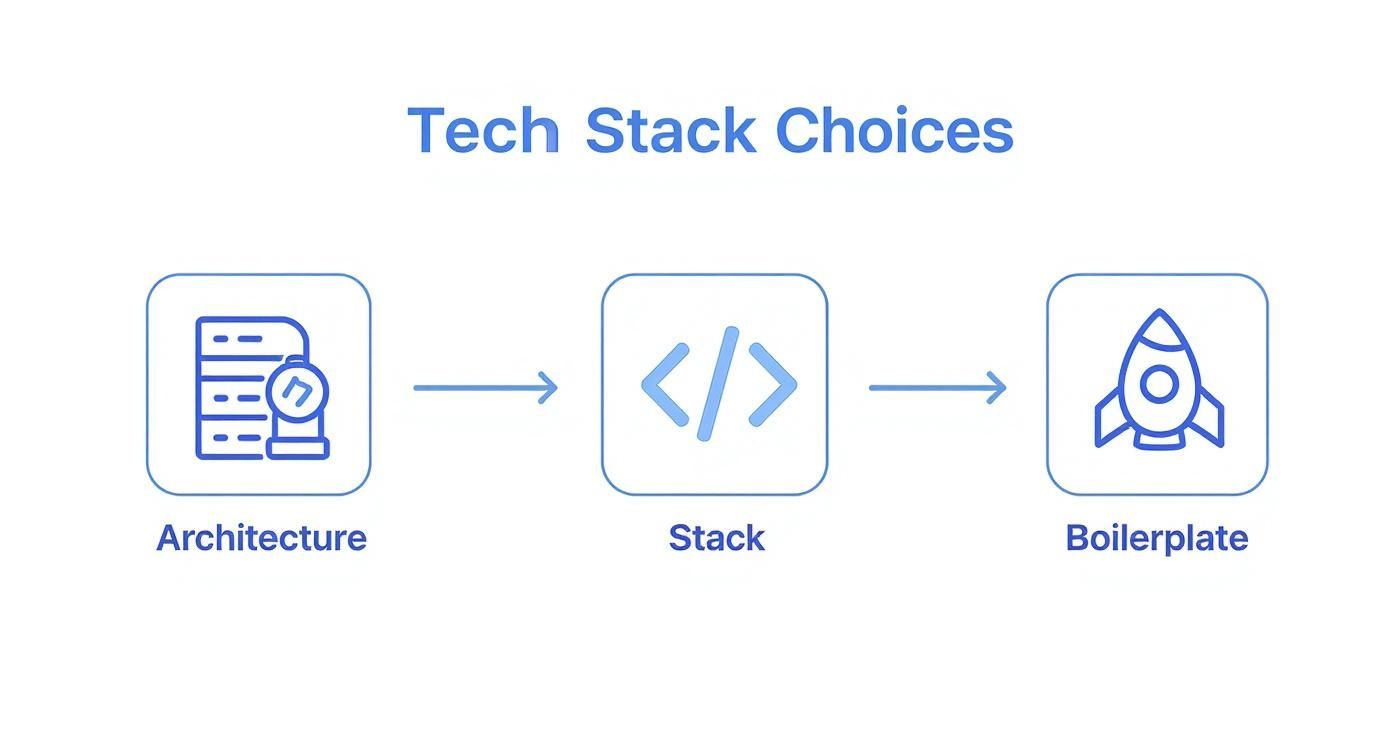
As you can see, after you’ve nailed down your core architecture and tech stack, opting for a pre-built foundation is the final step to accelerate everything.
Implementing Foundational SaaS Features
While a SaaS boilerplate like saasbrella handles most of this heavy lifting for you, it’s still crucial to understand the core components you’re building on. These are the absolute table stakes for any modern SaaS product.
- Secure User Authentication: This is way more than just a login form. It means proper password hashing, secure session management, and ideally, options for social logins (like Google) and two-factor authentication (2FA). Mess this up, and you’ll destroy user trust before you even get started.
- Subscription Management: Integrating a payment gateway like Stripe is the industry standard. Your application needs logic to handle different subscription plans, process recurring payments, manage cancellations, and deal with failed payments gracefully.
- Multi-Tenant Architecture: This is a fancy term for a simple concept: serving multiple customers (tenants) from a single instance of your app while keeping their data completely separate and secure. Even if you’re launching with just one customer, building with multi-tenancy in mind from day one will save you a massive refactoring headache later.
Infrastructure as Code and Cloud Providers
How you manage your servers and databases is just as important as the code itself. Manually clicking around in a cloud console to configure servers is slow, error-prone, and impossible to scale. The modern solution is Infrastructure as Code (IaC).
Tools like Terraform or Pulumi let you define your entire cloud setup—servers, databases, networking rules—in configuration files that live right alongside your application code. This means you can create, update, or even replicate your entire production environment with a single command. It’s version-controlled, repeatable, and completely transparent.
When it comes to picking a cloud provider like AWS, Google Cloud, or Azure, don’t get paralyzed by the endless list of services. For an MVP, you really just need three things:
- A way to run your application (e.g., AWS Fargate, Google Cloud Run).
- A managed database (e.g., Amazon RDS, Google Cloud SQL).
- A place to store files (e.g., Amazon S3, Google Cloud Storage).
Start simple. The specific cloud provider you choose matters less than your commitment to automating its management with IaC from day one. This disciplined approach is what separates a fragile MVP from a professional, production-grade foundation that’s ready for growth.
Launching Your MVP and Iterating with User Feedback
Hitting “deploy” isn’t the finish line; it’s the starting gun. The moment your SaaS MVP goes live, the real work begins. This is where all the assumptions you’ve made finally collide with reality. Your job description just changed from builder to learner.
This whole phase is about one thing: creating a tight, relentless feedback loop. You need to systematically pull in user data, spot the patterns, form educated guesses about how to make things better, and then ship changes fast to see if you were right. This cycle is the engine that drives a basic MVP toward true product-market fit.
Recruiting and Interviewing Your First Users
The most potent insights you’ll ever get will come from sitting down and talking with your first 10-20 users. These aren’t sales calls; they’re discovery sessions. Your mission is to find people who perfectly match the ideal customer profile you drew up during validation.
Your waitlist is the perfect place to start fishing. Don’t send a mass email. Reach out personally to every single person who signed up. Offer them a generous extended free trial or a steep discount in exchange for 30 minutes of their time. Using integrated waitlist and launch campaign tools can make managing this outreach a lot less chaotic.
When you get them on a call, your only job is to watch and listen—not to defend your product.
- Watch them use it. Get them to share their screen and try to complete the one core task your MVP was built for. Where do they hesitate? What confuses them? What makes them smile?
- Ask open-ended questions. Ditch the yes/no stuff. Instead of “Was that easy?” ask, “What were you expecting to happen when you clicked that button?”
- Listen for the “why.” When a user suggests a new feature, don’t just jot it down. Dig deeper. Ask, “That’s an interesting idea. Can you tell me more about the problem you’re trying to solve there?”
This kind of qualitative feedback is gold. It provides the context behind the numbers and explains why users are doing what they’re doing.
Measuring What Matters Most
While conversations tell you the “why,” hard data tells you the “what.” You need to track a handful of key metrics from day one to understand user behavior at scale. Tools like Mixpanel or Amplitude are built for exactly this.
Early on, it’s easy to get distracted by vanity metrics like total sign-ups. Don’t. Focus on the numbers that signal real engagement and value.
Your initial goal is not growth; it is retention and activation. A product that can’t keep its first users is a leaky bucket. Pouring more users into it won’t fix the fundamental problem.
Tracking just a few key performance indicators (KPIs) can tell you almost everything you need to know.
| Metric | What It Measures | Why It’s Important | Example Tools |
|---|---|---|---|
| User Activation Rate | The % of new users completing a key action (e.g., creating their first project) within their first session. | Shows if your onboarding and UX are effective. A low rate means users don’t “get” your product’s value. | Mixpanel, Amplitude, PostHog |
| User Retention | The % of users who return over time (e.g., in Week 1, Week 2, Month 1). Often viewed via cohort analysis. | This is the clearest signal of product-market fit. If users stick around, you’re providing ongoing value. | Baremetrics, ChartMogul, Mixpanel |
| Feature Adoption Rate | The % of active users who use a specific feature. | Helps you understand which features are delivering value and which aren’t, guiding your development priorities. | Pendo, Appcues, Amplitude |
| Customer Churn Rate | The % of paying customers who cancel their subscription each month. | Directly impacts revenue and viability. High churn is a red flag that your product isn’t solving the problem well enough. | Stripe, Paddle, ChartMogul |
Focusing on these metrics keeps you honest about whether you’re building something people actually want and will pay for.
Establishing a Rapid Iteration Cycle
The final piece of the puzzle is connecting what you’re learning from interviews and analytics back into your product. This is where the feedback loop becomes an engine for growth. It’s a simple, repeatable process that should become the heartbeat of your startup.
- Collect: Funnel all feedback—interview notes, support tickets, survey responses, and analytics data—into a single, organized place.
- Analyze: Sift through the noise and look for patterns. Are five different users getting stuck on the same screen? Is the same feature request popping up over and over?
- Hypothesize: Turn an observation into a testable idea. For example: “We believe that changing the dashboard layout to highlight the ‘New Project’ button will improve our activation rate by 15% because it makes the primary action more obvious.”
- Iterate: Build and ship the smallest possible change to test that hypothesis. Don’t over-engineer it.
- Measure: Check your analytics. Did the change have the effect you predicted? Whether it worked or not, you’ve learned something valuable that informs your next move.
This cycle of learning and improving is how you build a successful SaaS. It’s not about having all the right answers on day one; it’s about building a system that helps you find them faster than anyone else.
Common Questions (and Honest Answers) About Building a SaaS MVP
Building your first SaaS MVP is a minefield of questions. Everyone has them. Here are the straight-up answers to the ones we hear most often.
How Much Does an MVP Really Cost?
There’s no magic number. A simple SaaS MVP, built with freelancers or a small agency, typically lands somewhere between $15,000 to $50,000.
That figure can easily climb past $100,000 if you’re building something complex, need specialized skills like AI integration, or are working with a top-tier agency.
The key to keeping costs in check? Ruthless prioritization. Your bill is tied directly to your feature list. A smaller, focused MVP will always be cheaper and faster to build.
How Long Does It Take to Build an MVP?
A realistic timeline for a well-scoped SaaS MVP is three to six months. That covers everything from discovery and design to development, testing, and finally, launch day.
Pro Tip: You can slash this timeline by using a pre-built foundation or a SaaS boilerplate. When core features like authentication, payments, and multi-tenancy are already done, you can cut development time by weeks or even months. This lets you focus entirely on building your unique value proposition.
Anything under two months is probably cutting too many corners for a reliable product. If it’s stretching beyond six months, your scope is likely too big for an MVP. Remember, the goal is to get to market, start learning, and iterate.
Solo Founder or Technical Co-founder?
This is the classic dilemma, especially for non-technical founders. Building a production-grade SaaS application on your own is a monumental task. While no-code tools are great for validating ideas, they often hit a wall when you need to scale.
Here are the usual paths you can take:
- Find a technical co-founder: This is the ideal scenario for long-term alignment, but finding the right person can feel like searching for a needle in a haystack.
- Hire freelance developers: Platforms like Upwork can get you the talent you need quickly. This route requires a solid budget and sharp project management skills on your part.
- Learn to code (with AI assistance): Tools like Cursor or Claude can act as a “technical co-pilot,” helping non-developers build real applications. This path gives you the most control but comes with the steepest learning curve.
What Is the Biggest Mistake to Avoid?
Easy. Premature scaling.
It’s the number one killer of early-stage SaaS startups, and it shows up in a few different ways:
- Building too many features before you have a single paying customer.
- Over-engineering the architecture for traffic you don’t have yet.
- Blowing your budget on marketing before you’ve found product-market fit.
Your MVP is a tool for learning, not a rocket ship. Focus on building something your first ten customers absolutely love. If you can nail that, you’ve built a foundation you can actually grow from.
Ready to skip the DevOps headaches and focus on your product? saasbrella provides a complete, production-grade foundation with everything you need to launch your SaaS MVP in minutes, not months. Start your free trial and get building today at https://www.saasbrella.co.
Ready to build?
Get Started for Free. Build on a production-ready foundation with authentication, database, and deployment already configured.
No credit card required. Cancel anytime.