How to Build a SaaS Business From Idea to First Dollar
Building a SaaS business really boils down to three core stages: validate a real problem, build a lean solution to solve it, and launch in a way that gets your first users hooked. It’s a journey that puts customer needs first and tech second, making sure you’re building something people will actually pay for.
Charting Your Path From Concept to Company
Getting a SaaS business off the ground can feel overwhelming. It’s not about one brilliant idea; it’s about following a methodical process of finding a problem, executing a solution, and constantly iterating. This guide gives you the high-level roadmap we’ll be digging into, step by step.
The mission is simple: move from a rough idea to a real, scalable company. This path is broken down into a few distinct phases:
- Idea Validation: Before you write a single line of code, you need to confirm you’re solving a painful problem for a specific group of people who are willing to pay for a fix.
- MVP Development: Build the most minimal version of your product. It just needs enough features to be useful to your first users and get you the feedback you need.
- Strategic Launch: This is all about getting initial traction. You’re not aiming for thousands of users overnight; you’re looking for your first handful of paying customers.
- Growth and Scaling: Once you have paying customers, you’ll analyze what’s working, refine the product, and figure out how to grow your user base without breaking everything.
The opportunity here is massive. The global SaaS market is on track to hit $793.1 billion by 2029, growing at a staggering 19.38% each year. Widespread cloud adoption means there’s more room than ever for founders with smart solutions. You can dig deeper into these SaaS industry trends to see just how big the pie is.
This diagram shows the fundamental flow from idea to launch. It’s a simple but powerful visual.
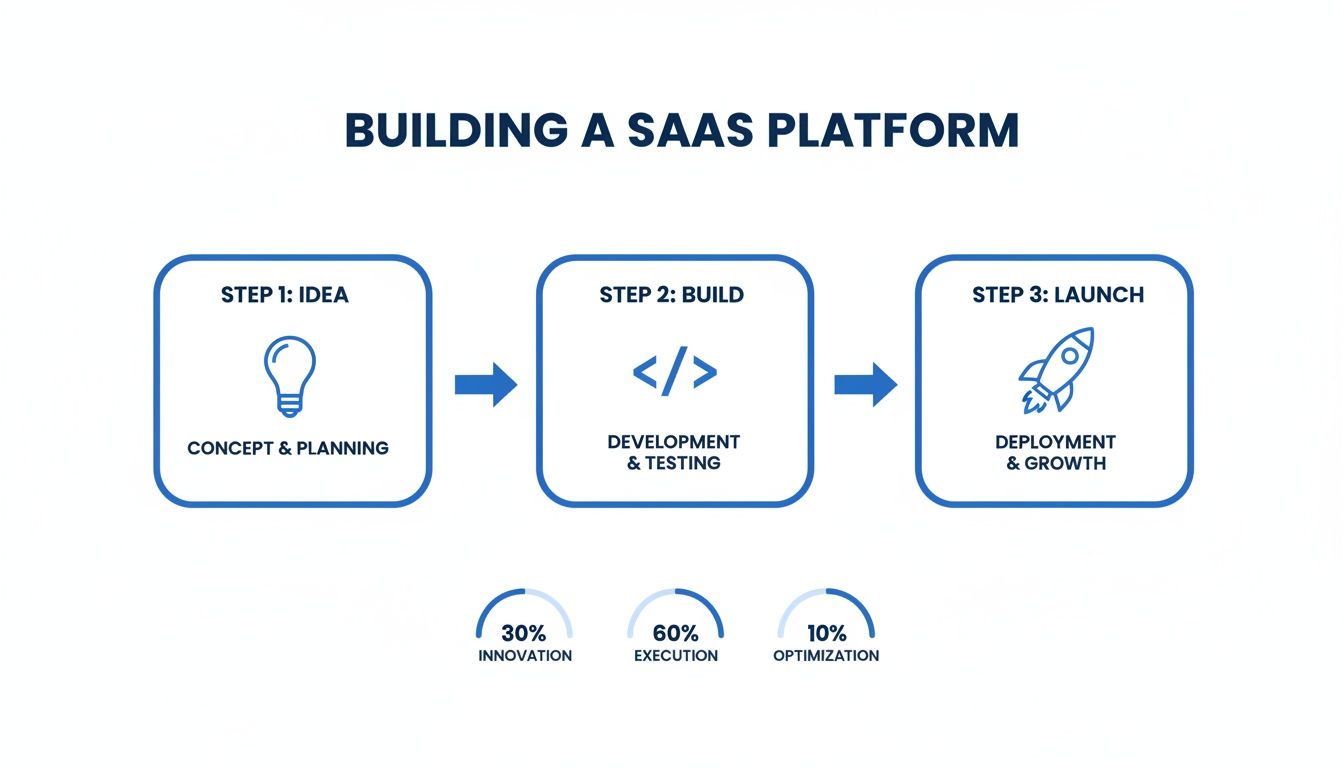
It’s a linear path, but each stage has its own unique goals and challenges. Think of it as a series of manageable steps, not one giant leap.
The SaaS Founder’s Journey At a Glance
To give you a clearer picture, here’s a quick summary of the journey ahead. It breaks down the entire process into distinct phases, each with its own clear goal and set of actions.
| Phase | Primary Goal | Key Action |
|---|---|---|
| Idea Validation | Confirm a real market need. | Talk to potential customers; run surveys; build a landing page to collect emails. |
| MVP Development | Build the core solution. | Choose a tech stack; focus on a single, critical feature; keep it simple. |
| Launch | Acquire first paying customers. | Launch on platforms like Product Hunt; reach out to your waitlist; start content marketing. |
| Growth & Scaling | Achieve product-market fit. | Analyze user metrics; gather feedback; iterate on the product and marketing. |
Seeing it laid out like this helps simplify what can feel like a complicated process. Each phase builds on the last, moving you closer to a sustainable business. Now, let’s dive into the details of each step.
Finding and Validating Your SaaS Idea
Every great SaaS starts with an idea, but an idea alone is worthless. Real value comes from validation—the process of proving you’re solving a painful problem people will gladly pay to fix.
This is the single most critical step. Get it right, and you’re building on a solid foundation. Skip it, and you’re just guessing, likely on your way to building a beautiful product nobody actually wants. The goal is to shift your mindset from “I think this is a cool idea” to “I know this specific group needs what I’m building.”
Uncover Problems in the Wild
The best ideas aren’t found in a brainstorming session. They’re discovered out in the wild, where your future customers are already talking about their frustrations. You just need to know where to listen.
Instead of locking yourself in a room, become an anthropologist. Go to the digital corners where your target audience hangs out.
- Reddit & Niche Forums: Subreddits like
r/smallbusinessor industry-specific forums are absolute goldmines. Search for posts where people are complaining, asking for tool recommendations, or describing hacky workarounds. Phrases like “Does anyone know a tool that does X?” or “I waste so much time manually doing Y” are giant, flashing signs pointing to a market gap. - Social Media Groups: Jump into Facebook and LinkedIn groups for specific roles, like “E-commerce Store Owners” or “Digital Marketing Managers.” Watch the comment threads. You’ll see the same questions and complaints pop up again and again. These are genuine, unfiltered pain points.
Your job isn’t to invent a problem. It’s to find an existing, painful one and build a smarter solution for it. The more acute the pain, the less you’ll have to “sell.”
Once you’ve spotted a recurring problem, resist the urge to immediately start coding. Your next move is to talk to the people who have that problem. To really get to the core of their needs, you have to master the art of the user interview. Learn how to conduct effective user interviews and you’ll uncover insights that a survey could never find.
Validate Interest Before You Build a Thing
Okay, you’ve identified a real problem. Now, you need to see if people care enough to act. This is where you test the waters with the smallest possible investment of time and money. This pre-MVP validation is what separates founders who succeed from those who build in a vacuum.
One of the best ways to do this is with a “smoke test” landing page. It’s just a simple, one-page website with a single mission: to clearly explain the problem and your proposed solution.
Your landing page needs three things:
- A Killer Value Prop: One clear sentence that explains what you do and for whom. For example: “The simplest way for freelance writers to track projects and automate invoices.”
- Focus on Benefits, Not Features: Don’t list features like “integrated calendar.” Sell the outcome: “Never miss a deadline again.” People buy the destination, not the plane.
- A Clear Call-to-Action (CTA): The entire page should drive visitors to one action: entering their email for early access or a launch discount. This is your currency of validation. An email address is a small commitment, but it’s a commitment nonetheless.
Now, drive a little bit of targeted traffic to the page. Share it in the same communities where you found the problem, or run a tiny ad campaign. If you can get a 10-15% conversion rate from visitor to email signup, that’s a powerful signal that you’re on the right track.
If the numbers are low, don’t panic. You’ve just learned a priceless lesson without spending six months coding. Tweak the messaging or revisit the idea itself. For some extra inspiration on what’s working right now, it can be helpful to check out a curated list of validated SaaS ideas.
Building Your Minimum Viable Product the Smart Way
Once you’ve got a validated idea, it’s time to build. But hold on—this isn’t about disappearing for six months to build the perfect, feature-packed app. The next step is crafting a Minimum Viable Product (MVP), which is the most bare-bones version of your product that delivers real value to your first users.
Think of the MVP as a tool for learning, not just a product. You build just enough to get it into the hands of real people, gather feedback, and figure out if you’re actually building something people want. So many founders get stuck in the “overbuilding” trap, burning time and money on features their initial customers couldn’t care less about. Your mission is to avoid that at all costs.
Prioritizing Your Core Feature Set
Building a lean MVP requires you to be ruthless with your feature list. The goal is to nail the single, most critical workflow that solves the core problem for your ideal customer. Everything else is just noise right now.
Start by sketching out the user’s path to solving their problem. What are the absolute, non-negotiable steps they need to take? That’s your MVP.
- Find the “Must-Haves”: These are the features that, if missing, render your product useless. For a task management tool, it’s probably just creating a task and assigning it. Nothing more.
- Shelve the “Nice-to-Haves”: Dark mode, slick integrations, and fancy reports are great, but they can wait. They add polish, not core value.
- Focus on One User Persona: Don’t try to be everything to everyone. Your MVP should be laser-focused on your ideal first customer, even if it means temporarily ignoring other potential users.
An MVP is all about getting the most learning for the least amount of effort. Treat every feature as a question you’re testing: “Do users actually get value from this?” If a feature doesn’t help you answer a critical business question, it has no place in your MVP.
Keeping the scope tight means you ship faster, which means you start learning from real users faster. For more on this, check out our guide on how to develop a SaaS MVP users actually want.
Choosing Your Tech Stack Wisely
Your tech choices right now should be all about speed and simplicity, not long-term scalability. You aren’t building for a million users on day one; you’re building to get your first ten paying customers. This is where modern tools can give you a serious edge.
Instead of building everything from the ground up—user auth, billing logic, databases, deployment—you can lean on a SaaS boilerplate or starter kit. These are pre-built foundations that handle all the boring, undifferentiated work every SaaS needs.
This screenshot shows the homepage for saasbrella, a platform built to give you exactly that foundation.
Using a tool like this gives you production-ready infrastructure for things like user accounts, subscriptions, and team management straight out of the box. It lets you skip the grunt work and focus entirely on the features that make your product unique. This approach can literally cut your development time from months down to weeks.
Here’s a quick look at how you might weigh your options when picking a tech stack for your MVP.
Tech Stack Considerations For Your SaaS MVP
Choosing the right tech path is a classic trade-off between speed, control, and cost. Here’s how different approaches stack up for an early-stage founder.
| Approach | Pros | Cons | Best For |
|---|---|---|---|
| From Scratch | Total control, infinite customization. | Extremely slow, high cost, requires deep expertise. | Well-funded teams with a highly unique product and plenty of time. |
| No-Code/Low-Code | Super fast for simple apps, very low technical barrier. | Limited scalability, vendor lock-in, poor for complex logic. | Non-technical founders validating simple ideas or building internal tools. |
| SaaS Boilerplate | Balances speed and control, includes core SaaS features. | Upfront cost, you manage all infrastructure yourself. | Developers who want a head start but prefer to manage their own hosting and deployment. |
| Managed Platform | Fastest time-to-market, infrastructure is handled for you. | Less control over underlying infra, often a subscription model. | Founders who want to focus 100% on their product and get to paying customers ASAP. |
For most indie hackers, a SaaS boilerplate or a managed platform like saasbrella hits the sweet spot. It gives you the speed you need without sacrificing the quality required to build a real business.
Integrating AI From Day One
Let’s be clear: AI is no longer some futuristic add-on. For a modern SaaS, it’s quickly becoming a foundational piece of the puzzle. If you’re not thinking about AI from the start, you’re already behind.
The global AI SaaS market is on an absolute tear, projected to rocket from $71.54 billion in 2023 to a staggering $775.44 billion by 2031, according to research on BetterCloud. This isn’t just a trend; it’s the engine driving the next wave of SaaS growth. You need to be on that train.
This doesn’t mean you need to go build your own complex AI models. It’s about using accessible APIs from providers like OpenAI or Anthropic to build “smart” features that give your users an immediate edge.
Here are a few practical AI features you could build into an MVP:
- Automated Summaries: If your app deals with any amount of text, use AI to generate instant summaries.
- Intelligent Onboarding: Personalize the setup flow for new users based on their role or stated goals.
- Data Analysis: Turn messy data into simple, actionable insights your users can actually understand.
Building a smart, lean MVP is the most direct path from a validated idea to a real business. Just focus on solving one problem exceptionally well, pick tools that get you to market faster, and build with the power of AI in mind from the very beginning.
Launching and Getting Your First Customers
Alright, you’ve hammered out a lean, genuinely useful MVP. Now for the fun part: actually showing it to people. A great launch isn’t some huge, flashy event; it’s about building a steady drumbeat of interest that brings your first, most critical customers through the door.
Your goal right now isn’t to get thousands of signups overnight. It’s to find those first 10 to 100 paying users. These are the people who will give you the feedback, the testimonials, and the revenue you need to survive and actually grow this thing. Think less mass marketing, more strategic, high-touch outreach.
Prime the Pump with a Pre-Launch Strategy
The best launches start way before you type out that “We’re live!” post. A smart pre-launch campaign builds anticipation and makes sure you have an engaged audience ready and waiting on day one. It’s all about warming up your potential customers so you aren’t just shouting into an empty room.
That waitlist you started back in the validation phase? It’s your primary tool now. Don’t just let those emails collect dust—nurture them.
- Share Behind-the-Scenes Updates: Send out an email every couple of weeks showing your progress. A screenshot, a quick note about a feature you just finished, or even a story about a bug you squashed. It makes your subscribers feel like insiders and builds a real connection.
- Offer a “Founder’s Deal”: Reward your earliest supporters with an exclusive, one-time offer. This could be a lifetime discount, extra features, or priority support. It creates a bit of urgency and makes those first users feel special.
- Ask for Their Input: Use your waitlist as a mini focus group. Send a quick survey asking for their thoughts on pricing or which features you should build next. This gives you priceless data and makes your audience feel invested in your success.
This whole process turns a cold email list into a community of advocates who are actually excited to see what you’ve built. They become your first—and most important—marketing channel.
Execute a Multi-Channel Launch Day
When launch day finally rolls around, your goal is to create a concentrated burst of attention across a few key channels. Spreading yourself too thin is a classic rookie mistake. Instead, focus your energy where your target audience is already hanging out.
Platforms like Product Hunt are a rite of passage for many SaaS founders, and for good reason. A solid launch there can drive thousands of visitors and a flood of signups in a single day. But success on Product Hunt is never an accident; it demands careful prep work.
A launch is just a moment in time, but the relationships you build are the foundation of your business. Treat every early user like a VIP, because they are. Their feedback and support are more valuable than any marketing budget.
Beyond a big platform launch, don’t forget your personal and professional networks. They’re invaluable. Reach out to friends, old colleagues, and industry contacts. Don’t just ask them to check it out; ask for their honest feedback and, if they like it, to share it with one or two people they think would benefit. This direct, personal approach is incredibly effective for getting those first few customers in the door.
From Launch to Lasting Growth
The initial buzz from a launch is temporary. The real challenge is converting that early momentum into a sustainable system for acquiring customers. This is where you get scrappy with early-stage content marketing and direct outreach.
Forget about complex SEO strategies for now. Your first pieces of content should be laser-focused on solving the specific problems of your ideal customer.
- Write “Pain Point” Content: Create blog posts or guides that directly tackle the frustrations you uncovered during your research. If your tool automates invoicing for freelancers, write an article titled, “The Freelancer’s Guide to Getting Paid on Time, Every Time.” This positions you as an expert and naturally introduces your product as the solution.
- Manual Outreach: Find potential customers in online communities and offer genuine help. Don’t just drop a link to your product and run. Answer their questions thoughtfully, and only mention your tool if it’s a perfect fit for their problem. This builds trust and goodwill.
- Collect Social Proof: The second you have a happy customer, ask for a testimonial. A single quote from a real user is more powerful than any marketing copy you could ever write. Feature these testimonials prominently on your website to build credibility with new visitors.
This hands-on, methodical work is how you build a SaaS business that lasts. It’s slow going at first, but securing those first dedicated users gives you the social proof and feedback loop you need to finally start scaling.
SaaS Pricing Models and Growth Metrics
Once you’ve landed those first few customers, you unlock one of the most powerful levers for growth: pricing. This isn’t just about slapping a price tag on your product. It’s about building a sustainable engine for your business by aligning the value you deliver with the revenue you earn.
Get this right, and you’re on your way. Get it wrong, and you’ll be fighting an uphill battle. The first step is picking a model that actually makes sense for your customers and scales as they grow with you.
Choosing the Right SaaS Pricing Model
There’s no magic bullet for pricing, but thankfully, you don’t have to reinvent the wheel. Most successful SaaS companies use one of a few proven models. Each has its own rhythm and is better suited for certain products and customers.
Here’s a quick rundown of the most common approaches you’ll see in the wild:
- Tiered Pricing: This is the classic you see everywhere—think Basic, Pro, and Enterprise plans. Each tier comes with different features or usage limits at different price points. It’s effective because it lets different customer segments self-select the plan that fits their needs and budget.
- Usage-Based Pricing: Simple and fair: customers pay only for what they use. Think about services like AWS or Twilio, where you’re billed for data storage or API calls. This is perfect when your product’s value is directly tied to consumption because it scales perfectly with your customer’s usage.
- Flat-Rate Pricing: One price, all the features. This model is brilliantly simple to communicate and sell. The big risk? You might leave a lot of money on the table from larger customers who would have gladly paid more for the value they receive.
- Per-User Pricing: A straightforward model where you charge a fixed price per user, per month. It’s predictable and easy to understand, making it a go-to for team collaboration tools. The main downside is that it can sometimes discourage wider adoption if the cost per seat becomes a barrier.
The trick is to anchor your pricing to your “value metric”—the thing your customers get more of as they use your product more. For a project management tool, it might be active projects. For an email marketing platform, it’s usually the number of subscribers. Tying your price to that metric ensures your revenue grows as your customers find more success with your product.
The Essential Growth Metrics You Must Track
With your pricing set and revenue trickling in, you can’t afford to fly blind. You need data to understand the health of your business and make smart moves. While you could track dozens of metrics, a few are absolutely non-negotiable for any early-stage SaaS founder.
Metrics are more than just numbers on a dashboard; they are the vital signs of your business. They tell you what’s working, what’s broken, and where your biggest opportunities are. Ignoring them is like driving with your eyes closed.
Focusing on a handful of core metrics will give you 80% of the insights you need with just 20% of the effort. These are your North Stars.
Monthly Recurring Revenue (MRR)
This is the lifeblood of your SaaS business. MRR is the predictable, recurring revenue you can count on every single month. It’s the sum of all the monthly fees from your paying customers.
But tracking the top-line number isn’t enough. You have to break it down:
- New MRR: Revenue from brand-new customers. This is your growth.
- Expansion MRR: Extra revenue from existing customers who upgrade or add services. This is your best growth.
- Churned MRR: Revenue you lose when customers cancel or downgrade. This is the leaky bucket you need to plug.
The fundamental equation for SaaS growth is simple: make sure your New and Expansion MRR consistently outpace your Churned MRR.
Customer Acquisition Cost (CAC)
Simply put, CAC is what it costs you in sales and marketing to get a single new customer. To figure it out, just divide your total sales and marketing spend over a given period by the number of new customers you signed up in that same timeframe.
For instance, if you spent $5,000 on ads last month and landed 10 new customers, your CAC is $500. Knowing this number is critical—it tells you whether your growth engine is sustainable or if you’re just burning cash.
Lifetime Value (LTV)
LTV is the total amount of revenue you can reasonably expect to generate from a single customer throughout their entire time with you. A deep understanding of your business’s financial health requires mastering SaaS customer lifetime value calculation, a key growth metric. A high LTV is the hallmark of a healthy SaaS business because it means customers are sticking around and paying you for a long time.
The real magic happens when you compare LTV to CAC. A healthy SaaS business should aim for an LTV:CAC ratio of at least 3:1. This means for every dollar you spend acquiring a customer, you should expect to get at least three dollars back.
If your ratio is lower than that, you’re probably spending too much to acquire customers who don’t stick around long enough to become profitable. This ratio is the ultimate stress test for your business model.
Scaling Operations and Your Legal Foundation
Once you start getting traction, the game completely changes. Your focus has to shift from just building a cool product to building an actual, sustainable company. This is where the less glamorous but absolutely critical work of operations and legal groundwork comes in.
Getting these foundations right early on saves you from colossal headaches later. It’s what allows your business to handle growth without imploding from messy operations or legal blind spots. This is how you build a real asset, not just a side project that fizzles out.
Structuring Your Business for Growth
One of the first real “business owner” decisions you’ll face is choosing a legal structure. It’s incredibly tempting to just run things as a sole proprietor, but that’s a huge risk. It leaves your personal assets completely exposed if something goes sideways.
For most indie founders, forming a Limited Liability Company (LLC) is the smartest, simplest move. It creates a vital layer of protection by separating your personal finances from your business.
- Asset Protection: An LLC acts as a legal shield. If your business gets sued, your personal assets—like your house and savings—are generally protected.
- Credibility: Let’s be honest, having an official business entity like “MySaaS, LLC” just looks more professional. It builds trust with customers and potential partners.
- Simplicity: Compared to a full-blown corporation, LLCs are way easier to set up and maintain. The compliance and paperwork are minimal.
The process is surprisingly straightforward in most places and can often be done online in just a few hours. Don’t put this off. It’s the first real brick you lay for a durable business.
Your Essential Legal Documents
With your business entity in place, the next step is getting your core legal documents sorted. These aren’t just boilerplate text you can ignore; they are the rules of engagement between you and your customers. They protect both of you by setting crystal-clear expectations.
Before you even think about charging your first customer, you need two documents at a minimum:
- Terms of Service (ToS): This is your contract with the user. It spells out what they can and can’t do with your software, your policies on payments and refunds, and crucially, it limits your liability.
- Privacy Policy: This document explains exactly what user data you collect, how you use it, and how you protect it. With regulations like GDPR and CCPA, a clear and accurate privacy policy isn’t just a good idea—it’s a legal requirement.
Think of your legal documents as the foundation of your house. You don’t see them every day, but they’re what keeps everything from collapsing when a storm hits. Getting them right from the start is non-negotiable.
Hiring a lawyer is the gold standard, of course, but that can be prohibitively expensive for an early-stage founder. Services exist to help generate these documents, but you have to make sure they are tailored to your specific business model. To get a better handle on what’s involved, you can learn more about the essential legal requirements for SaaS startups and why they matter so much.
Setting Up Scalable Systems
Finally, as you grow, you need systems that can handle more users without demanding more of your personal time. This means automating the repetitive tasks that will absolutely drown you otherwise.
The two big ones to focus on are customer support and billing. For support, a simple help desk tool can keep tickets organized and let you build out a knowledge base over time. For billing, a robust payment processor like Stripe is non-negotiable. It automates subscriptions, handles failed payments, and manages invoices without you having to lift a finger.
Building these operational muscles early is a key part of learning how to build a SaaS business that can actually scale beyond just you.
Your Top Questions, Answered
Every founder has questions when they’re just starting out. It’s part of the process. Here are some of the most common ones we hear, along with some straight-up answers based on what we’ve seen work.
How Much Does It Really Cost to Start a SaaS?
This one varies wildly. Honestly, it can be anything from a few hundred bucks to well over six figures.
If you’re an indie hacker who can code and you’re smart about your tools—say, using a boilerplate like saasbrella—you could get your first version live for under $500. That covers essential tools and maybe a little for initial hosting.
On the other end of the spectrum, if you’re hiring developers or bringing in an agency to build your MVP from scratch, you could easily be looking at $50,000+ before you even have your first user.
The biggest factors that swing the cost are:
- Your own tech skills: Can you handle the code yourself? If so, your biggest cost is time.
- How you build: Are you starting from a solid foundation or building every single feature from the ground up?
- Your marketing plan: Are you hustling on free channels like social media and content, or are you dropping cash on paid ads from day one?
The leanest path is for a technical founder to use a SaaS foundation to slash development time. This lets you put your initial cash into essential tools and small, targeted marketing experiments to land those crucial first customers.
What’s a Good SaaS Valuation Multiple?
Valuation multiples for private SaaS businesses are always shifting with the market. Right now, heading into 2025, a typical multiple is hovering around 4.8x to 5.3x of your Annual Recurring Revenue (ARR).
But that’s just an average. A high-growth company with fantastic net revenue retention (meaning customers stick around and spend more over time) can demand much, much higher multiples. The top-tier public SaaS companies? They can trade at over 14x ARR.
Your specific multiple really boils down to your growth rate, how many customers you’re losing (churn), and the overall health of the market when you’re being valued.
How Long Does It Take to Build a SaaS Product?
Getting that first version—the Minimum Viable Product (MVP)—out the door can take anywhere from a few weeks to six months. It really depends on your approach.
If you use a pre-built foundation, you can seriously shorten that timeline, often getting something launched in just 2-4 weeks.
Building from scratch with a small team? You’re more likely looking at 4-6 months. The trick is to stay disciplined. You’re building the minimum viable product, not the final, feature-packed dream platform. The goal is to get to market, get real users, and start learning as fast as humanly possible.
Ready to stop wrestling with DevOps and start building your product? saasbrella provides a complete, AI-ready foundation so you can launch in minutes, not months. Get started with your 14-day free trial.
Ready to build?
Get Started for Free. Build on a production-ready foundation with authentication, database, and deployment already configured.
No credit card required. Cancel anytime.